
Immunoglobulin G is an antibody class whose conventional four-chain architecture supplies the example above.
An ordinary IgG has two matching immunoglobulin heavy chains and two matching immunoglobulin light chains, abbreviated . Its gamma-type immunoglobulin heavy chains contribute both to recognition and to interactions with immune partners.[ref]
Antibody Structure and Molecular Immunology by Gerald M. Edelman. Gerald M. Edelman, Antibody Structure and Molecular Immunology, printed pp. 35–37, Table 1 and Figure 3: gamma chains, four-chain architecture and separate functional regions
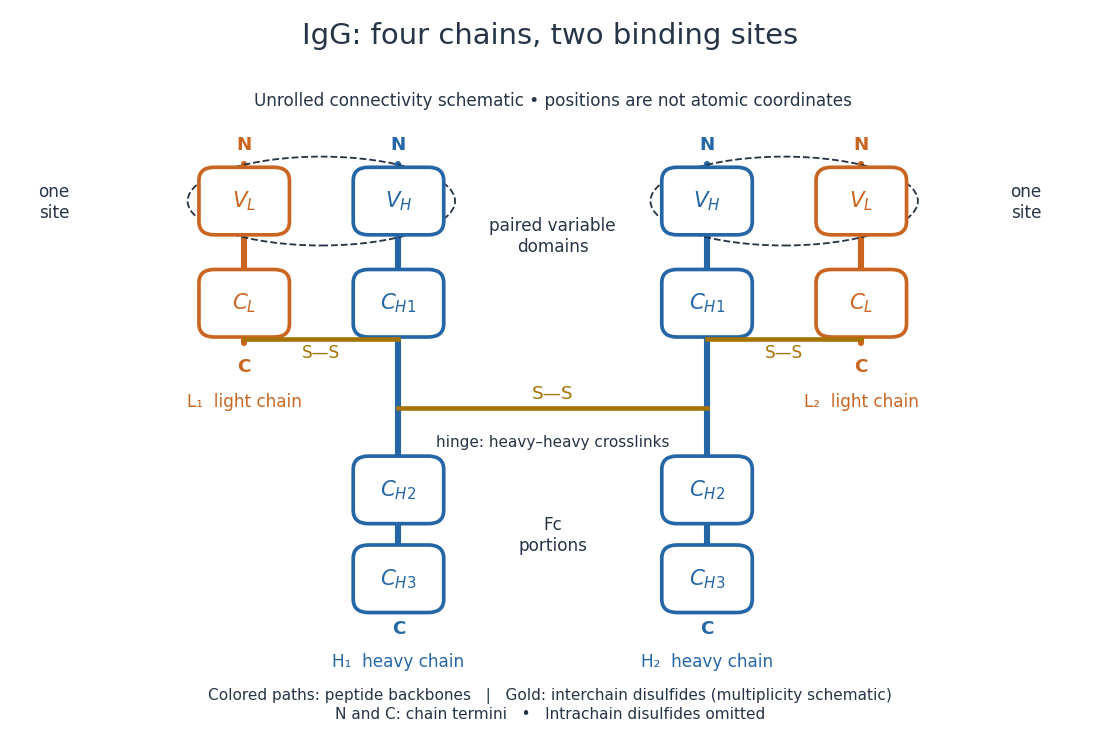
IgG chain continuity and protein disulfide bond connectivity
. Original chain-connectivity schematic. Gold crossbars denote interchain protein disulfide bonds; intrachain crosslinks are omitted. The drawn crossbar count and geometry illustrate connectivity, rather than atomic coordinates or a universal IgG subclass inventory. Details.
A useful way to read this picture is to follow a single polypeptide chain continuously from its N-terminus to its C-terminus, then examine the crosslinks separately. The same immunoglobulin heavy chain contributes to a Fab fragment and to the Fc fragment; these named fragments are not pre-existing separate chains. Conversely, one Fab fragment contains material from two different chains. The protein primary structure and the fragment inventory therefore answer different questions about the same protein.
New to topics? Read the docs here!