Leading-edge radius estimation from sampled coordinates
ID: leading-edge-radius-estimation-from-sampled-coordinates

Leading-edge radius estimation from sampled coordinates infers local nose curvature from a finite set of profile measurements. Unlike reading a radius from a drawing, it must account for the coordinate scale, the fitted nose location and the range of points treated as a local model.
Choose coordinates with a smooth nose at the origin and a vertical tangent. A local model iswhere is the true airfoil leading-edge radius. Ignoring the quartic term gives the quotient estimate . Even exact coordinates then givefor the displayed quadratic-plus-quartic model. Moving closer to the nose reduces this model bias, but also makes the horizontal displacement small relative to a fixed coordinate error.
For an original numerical example, set and . At , the exact horizontal displacement is and the quotient gives . If is treated as exact while has an absolute error bounded by , the inferred radius ranges from about to . At , the coordinate-error range narrows to about –, but the exact-coordinate quotient is already biased down to .
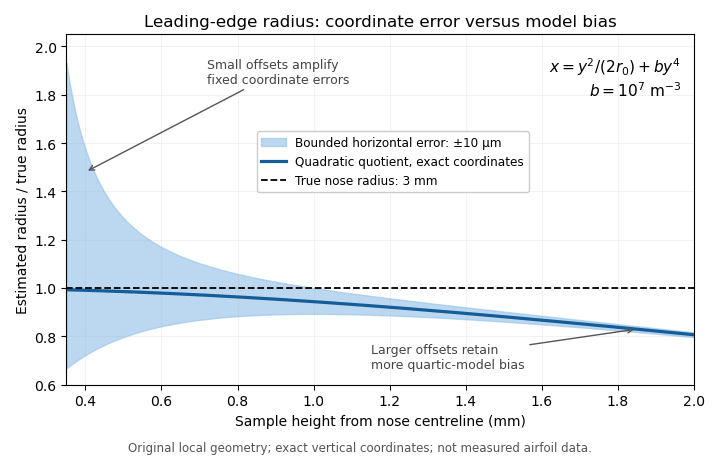
Leading-edge radius quotient for a stipulated quartic nose with true radius 3 mm: small offsets amplify coordinate error, while larger offsets retain more quadratic-model bias. Original calculation; not measured airfoil data.
Details. 
A least squares fit can combine several points. If the origin and are known and errors are assigned to , minimizing with positive weights givesprovided the denominator and fitted coefficient are positive. This fit does not remove an omitted quartic term; the leading-edge radius fitting window controls the tradeoff between local-model error and coordinate noise. An uncertain nose origin or appreciable errors in both coordinates require a correspondingly expanded fitting model.
A practical geometry check uses calibrated profile coordinates, tests several fitting windows and reports the variation alongside measurement uncertainty. Analytic profiles provide an implementation check: the four-digit family has the known relation .[ref]
Applied Computational Aerodynamics by W. H. Mason. Appendix A, equation (A-5), four-digit leading-edge radius
That family relation validates a calculation on a known profile; it does not determine the radius of an unrelated measured nose. New to topics? Read the docs here!