
The Life glider is a five-cell pattern that recreates its shape after four generations, shifted one cell along each coordinate. Use increasing rightward and increasing downward, as in the figure, and start from the live setEvery cell outside starts dead. Applying the Conway's Game of Life rule, rather than moving the drawing by hand, gives:
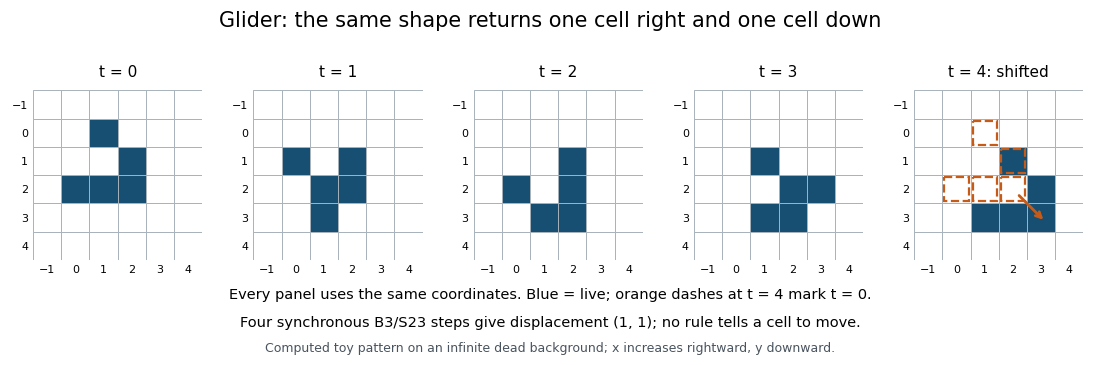

For an exact check of every frame, the intermediate live sets areHere means add to each ordered pair in . In the first step, the live cells and have respectively one and one live neighbors, so die; the other three have respectively three, three and two and survive. Exactly and are born, with three live neighbors each. This derives and explains how motion can occur while individual cells merely switch states.
Because the rule uses the same relative neighbors at every position, applying the global update function and applying a translation commute. Thus for every generation ; the four-step calculation establishes continued motion on the infinite board. The average displacement is cells per generation, or Euclidean distance per generation. The live-cell count happens to stay five in these frames, but the rule does not conserve live-cell count in general: a single isolated live cell dies immediately. The Life glider persists indefinitely in an otherwise empty infinite board; encounters with other patterns or a finite implementation's edge can change that conclusion.
// Destination: computer-science.bigb
New to topics? Read the docs here!