
The light cone of a spacetime event consists of together with the spacetime events having null separation from it. In the coordinates of an inertial frame centered on , it obeysFor it traces an expanding spherical flash of light, with radius at time ; for it describes possible incoming light rays. A spacetime diagram with one spatial coordinate shows the two lines . The apparent angle uses equal scales for and and is not a separate physical angle.
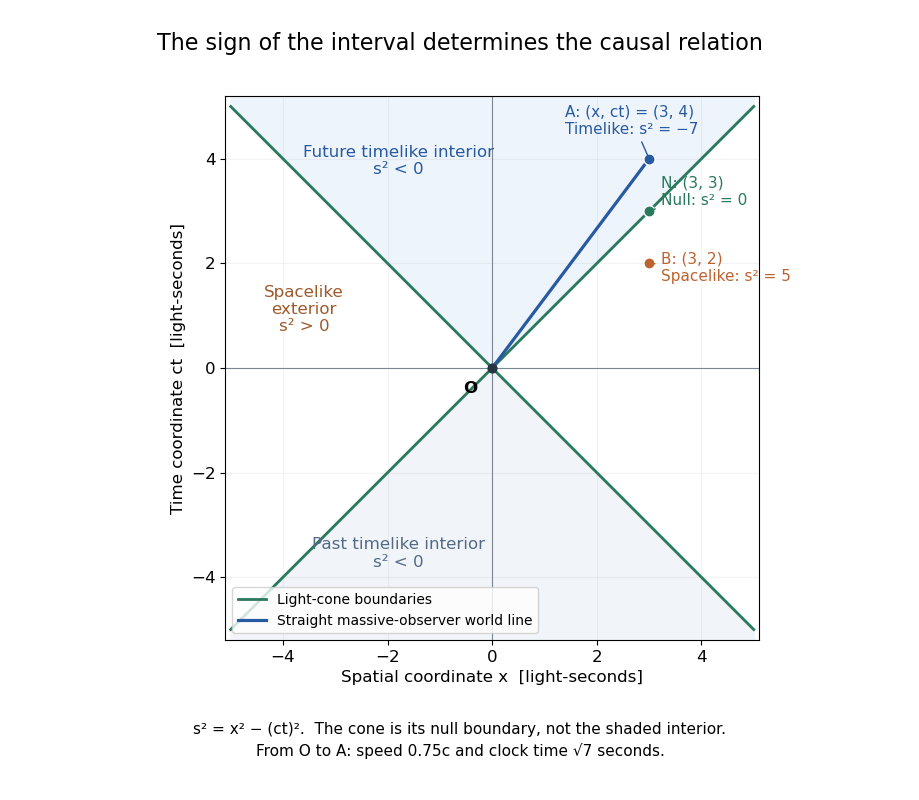
Light-cone boundaries separate timelike, null and spacelike events relative to the origin
. Details. The light cone is the boundary, while its interior has timelike separation from . An outgoing light ray follows the boundary; a future-directed massive observer's world line remains inside it. The exterior has spacelike separation: no signal travelling at or below the speed of light can connect its spacetime events directly to . This separates possible causal influence from merely being assigned a later coordinate time.
In the diagram, is inside the future boundary, is on it, and is outside. Their squared Minkowski intervals are respectively in . Thus occurs later than in the displayed inertial frame while still being unable to receive a light-speed-or-slower signal sent from .
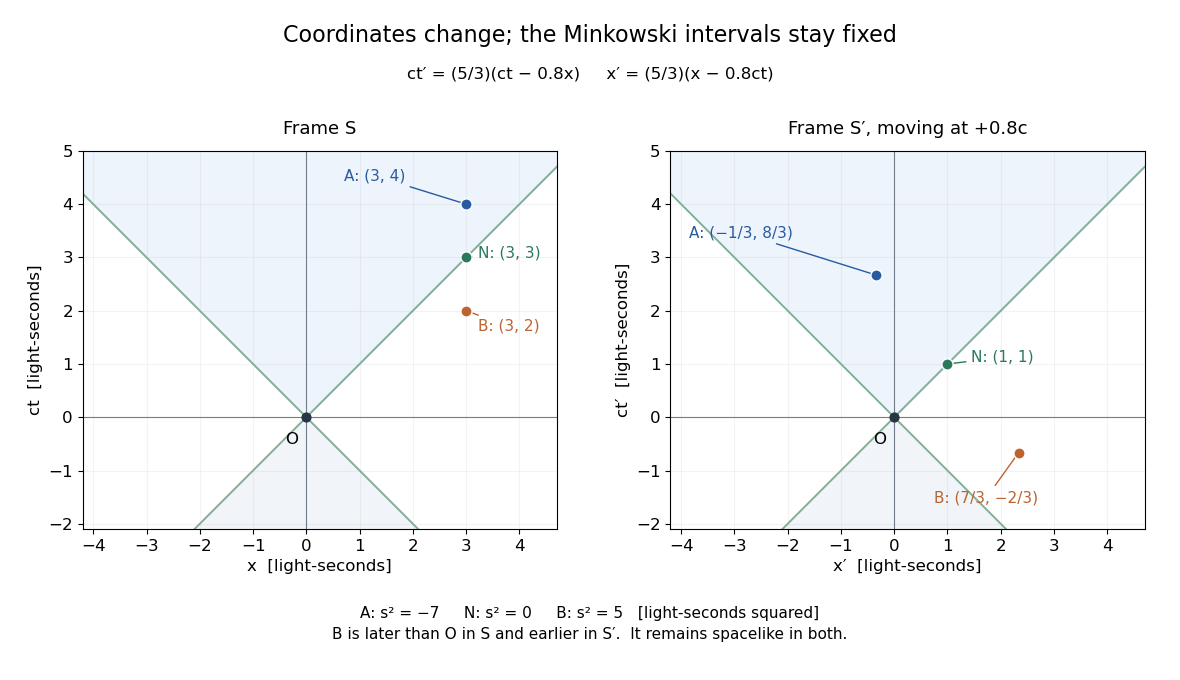
The usefulness is immediate for an experiment: a detector's reading can depend on a source event only if a causal influence can reach it. A Lorentz boost changes coordinates but preserves this classification. For a boost with and Lorentz factor , applying the Lorentz transformation gives, in light-second length units,The corresponding squared Minkowski intervals remain . In particular is now earlier than , which is allowed for spacelike separation; remains later.

A light cone is a crucial concept in the theory of relativity, particularly in the context of spacetime. It helps illustrate how information and causal relationships are structured in the universe according to the speed of light.



The key insights that it gives are:
- future and past are well defined: every reference frame sees your future in your future cone, and your past in your past coneOtherwise causality could be violated, and then things would go really bad, you could tell your past self to tell your past self to tell your past self to do something.
- every other event (to right and left, known as spacelike-separated events) can be measured to happen before or after your current spacetime event by different observers.
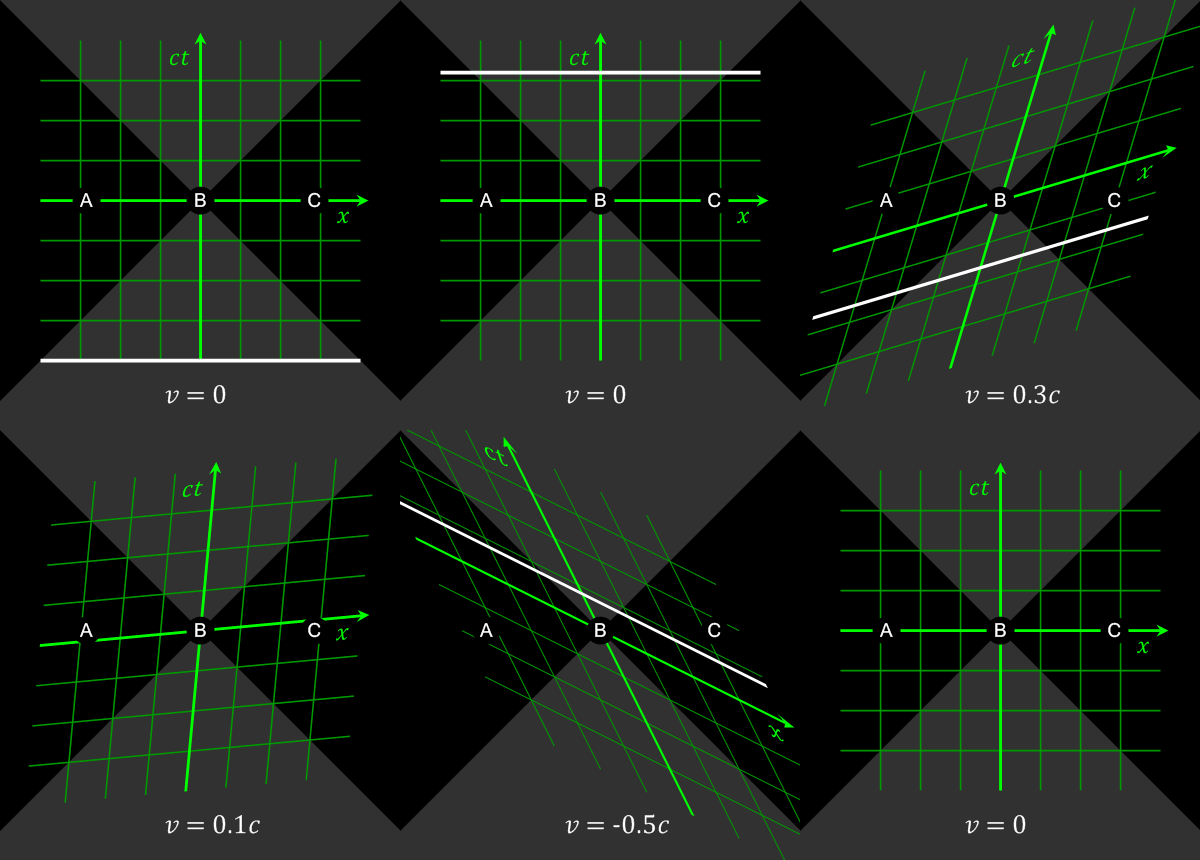
Animation showing how space-separated events can be observed to happen in different orders by observers in different frames of reference
. Source. 
New to topics? Read the docs here!