
Linear search, also called sequential search, examines a finite sequence from its beginning, performing an equality test on each entry until one matches the target or the entries run out. It needs no sorted array or total order on the values. This makes it useful for a small collection, a one-off lookup, or data available only in succession: the next entry is enough to make progress.
Specify the answer precisely. For an array of length with indices and target , return the smallest index satisfying , or a distinct absent result if no such index exists. Repeated values are allowed. In this contract, finding a later duplicate is insufficient when an earlier match exists. Assume the input remains unchanged during the search and each equality test terminates with a stable truth value expressing the intended matching relation.
Here is an implementation in Python; The official Python sequence method
None represents absence and is distinct from the valid index zero:def linear_search(entries, target):
for index, entry in enumerate(entries):
if entry == target:
return index
return Nones.index(x) likewise specifies the first occurrence, but signals absence by raising ValueError. An API's absent-result convention belongs to its contract.[ref]Take the original unsorted array . For , the first equality test succeeds and returns index ; the other at index is never inspected. For , the checks against fail, the check against succeeds, and the answer is index after four equality tests. For absent target , all five equality tests fail and the answer is
None. On the empty sequence, there is no entry to inspect: return None with zero equality tests.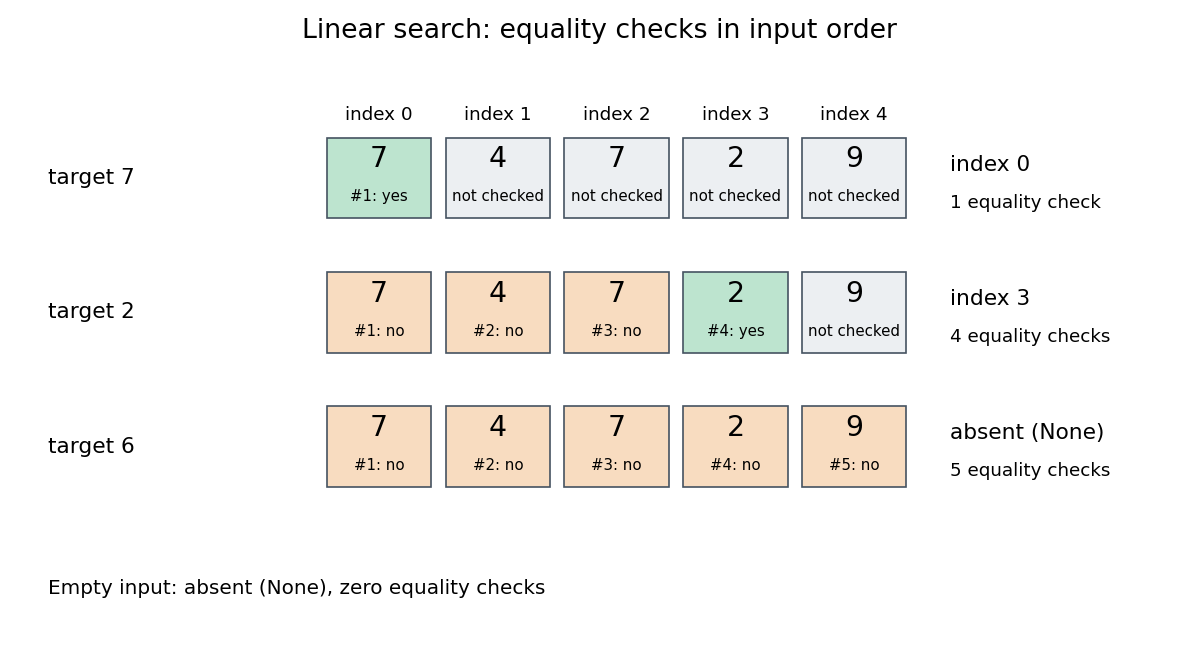
Value order never justifies skipping an entry in this algorithm. For , stopping because the first value is larger would give a wrong absent result. Any permutation of the input remains searchable by linear search, although the first matching index and number of equality tests can change. By contrast, binary search uses a total order and the sorted array property to discard whole candidate ranges. Its logarithmic time complexity additionally assumes cheap access to middle entries; a sorted linked list does not acquire constant-cost indexed access merely by being sorted. Sorting for a single query also has a cost, and changes positions relative to the original sequence.


Linear search, also known as sequential search, is a basic search algorithm used to find a specific value (known as the target) within a list or an array. The algorithm operates by checking each element of the list sequentially until the target value is found or the entire list has been searched. ### How Linear Search Works: 1. **Start at the beginning** of the list. 2. **Compare** the current element with the target value.
New to topics? Read the docs here!