
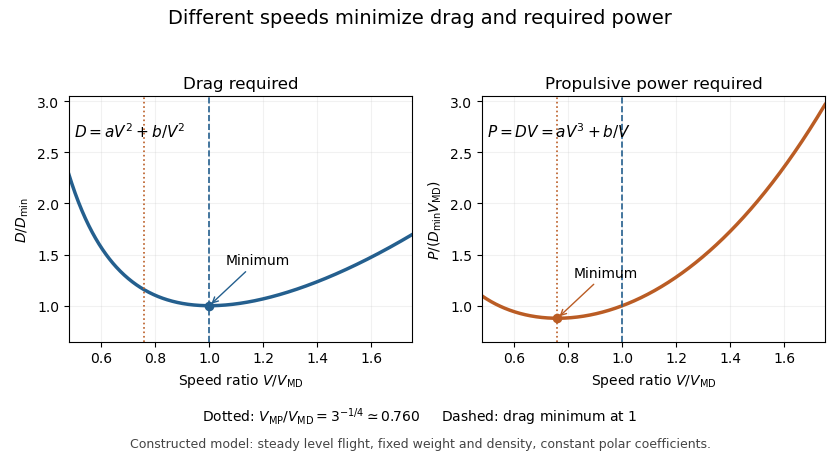
The minimum-power speed minimizes the mechanical propulsive power required to sustain the specified flight state. For steady level flight with drag , the required power is , using speed through the air. Minimizing this product is a different problem from finding the minimum-drag speed.
With the fixed-coefficient parabolic drag polar, writeDifferentiation givesThus the stationary point is the unique global minimum for positive speed:At this point, : the decreasing drag contribution is three times the increasing contribution, rather than equal to it. In lift-coefficient form, .
For an original numerical model with and in consistent metre-second-newton units, m/s and m/s. The power minimum is about 22.461 kW, with drag about 739.01 N. At the drag minimum, drag is only 640 N but power is 25.600 kW. The lower power comes from the combination of force and speed, despite the greater force.
In shallow steady unpowered descent, the gravitational energy-loss rate approximately balances , so minimizing required power relates to minimum sink speed when the same assumptions hold. This is consistent with the FAA's distinct minimum-sink and best-glide points.[ref] A changing propulsive efficiency changes the input-power objective: if , a stationary point satisfies , not generally .
Attainability must also be checked. The model's optimal lift coefficient can exceed the allowed range before aerodynamic stall. The formula concerns the stated required mechanical power, not a universal minimum of fuel consumption or an operational speed recommendation.

New to topics? Read the docs here!