
For integers and a positive integer modulus , modular congruence meansThus for some integer : the two integers differ by complete cycles of length . For example, because , and because . A modular congruence need not be an equality of integers.
On a twelve-position clock labelled , adding five to nine follows . Hence : the final position remembers the remainder while forgetting a complete revolution.
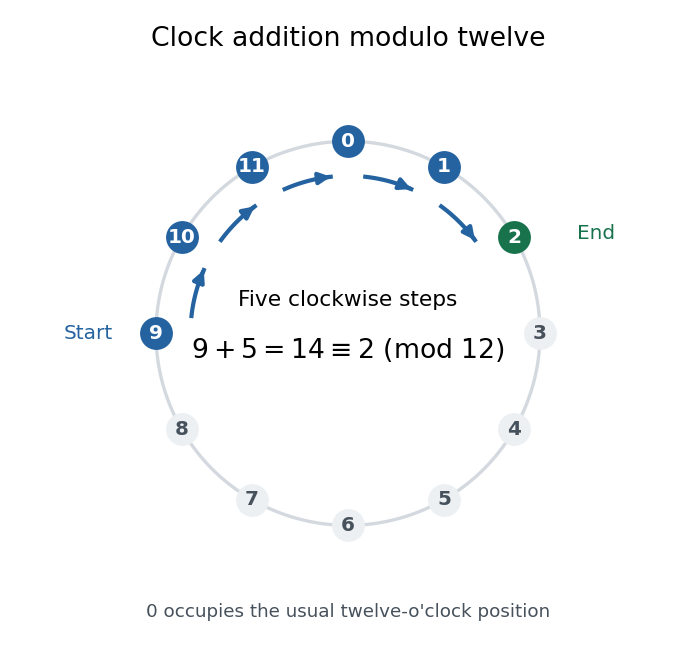

The same idea tracks any count repeating every steps. It also lets us compute sums and products with small residue classes, reducing intermediate results without changing the final class. The justification comes from addition and multiplication being well-defined on residue classes.
In Disquisitiones arithmeticae (1801), Carl Friedrich Gauss defines modular congruence by divisibility in article 1; article 2 describes the integers and adopts . These passages document his presentation and notation, without claiming that repeating remainders began in 1801. [ref]
https://la.wikisource.org/wiki/Disquisitiones_arithmeticae/Sectio_prima. Gauss, Disquisitiones arithmeticae, section I, articles 1–2; original text in the 1870 collected edition
New to topics? Read the docs here!