Nearest-neighbour model of graphene
ID: nearest-neighbour-model-of-graphene

Take a planar honeycomb lattice with two sites per primitive cell and one localized atomic orbital per site. In this explicitly idealized tight-binding model, all three nearest-neighbour hopping matrix elements are , with ; there is no on-site offset or further-neighbour hopping. Ignore Electron interactions and treat physical spin as a separate degeneracy. Let the bond length be , and choose the three vectors from an site to its neighbours asThe Bloch state amplitudes on form a two-component vector. A consistent phase convention gives the HamiltonianIts characteristic equation is , giving the two displayed energy bands. The two-component structure comes from the two sites, rather than two values of physical spin. This is a particularly small matrix model in which a crystal's geometry creates an unexpected low-energy law.
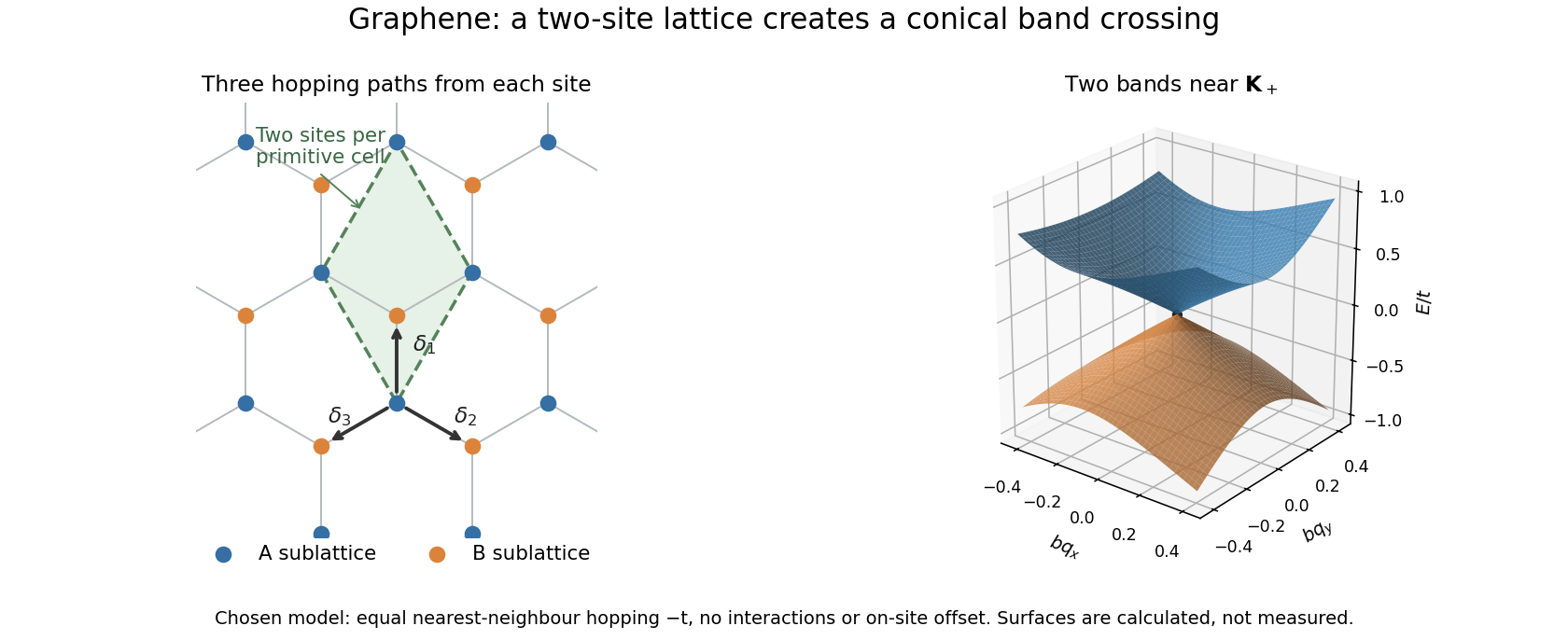
A honeycomb lattice produces two touching electronic bands
. Original nearest-neighbour model with the defined bond vectors. The surface shows the calculated bands near one zero of , with distance in units of inverse bond length and energy in units of the hopping magnitude. These are model energies, not measured band data. Source. Details.
Historically, Philip Russell Wallace used a tight-binding model to investigate the electronic band structure of graphite in 1947. The material in that paper was layered graphite; the single-sheet model here isolates one simpler part of the problem.[ref]
The Band Theory of Graphite by Philip Russell Wallace. Publisher abstract: tight-binding bands and Brillouin zones of graphite; published 1 May 1947
New to topics? Read the docs here!