Nested contact-study allocation
ID: nested-contact-study-allocation

Nested contact-study allocation chooses how many independent contacts to prepare and how many readings to take within each contact. In a nested wringing-repeatability study, new contacts sample between-wring variability, whereas extra readings of one unchanged contact mainly reduce readout scatter.
For wrings and readings per wring, suppose independent between-wring variance is and independent readout variance is . The overall mean hasAn original planning model assigns cost to preparing a wring and cost to each reading. With fixed budget , a continuous relaxation givesFor positive costs and nonzero , differentiating with respect to yieldsThis balances the cost of new contacts against the benefit of repeated readings. It is not a universal required replication count; integer counts, minimum study sizes and other constraints still apply.
For stipulated costs 9 minutes per wring and 1 minute per reading, with , and budget 180 minutes, the continuous optimum is nine readings per wring. Ten wrings then fit exactly, giving standard deviation for the mean. Eighteen wrings with one reading each give about 1.491 nm; four wrings with thirty-six readings each give about 1.118 nm.
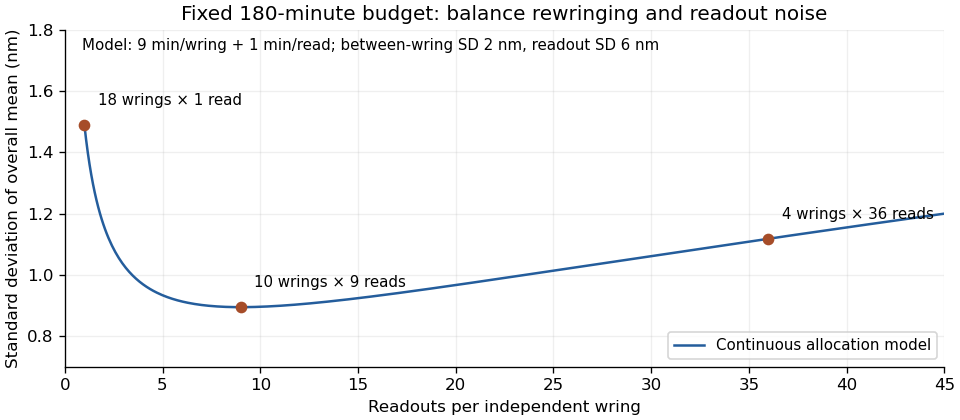
Original fixed-budget model comparing rewringing with repeated readout; all costs and variance components are stipulated
. Details. 
The variance components need pilot information. Wringing-allocation pilot uncertainty can change the preferred allocation, especially if a small pilot wrongly suggests negligible between-wring variation. Include enough independent preparations to assess that level rather than optimizing solely for an assumed mean variance.
The physical contact can also change with time, handling or surface damage. NIST documents dependence of wringing films on conditions and elapsed time.[ref] Drift, preparation trends and shared reference uncertainty require additional terms; they do not necessarily decrease by adding readings according to this independent-effects formula. State the objective and the constraints with the final design.
New to topics? Read the docs here!