Nested contact-study allocation chooses how many independent contacts to prepare and how many readings to take within each contact. In a nested wringing-repeatability study, new contacts sample between-wring variability, whereas extra readings of one unchanged contact mainly reduce readout scatter.
For wrings and readings per wring, suppose independent between-wring variance is and independent readout variance is . The overall mean hasAn original planning model assigns cost to preparing a wring and cost to each reading. With fixed budget , a continuous relaxation givesFor positive costs and nonzero , differentiating with respect to yieldsThis balances the cost of new contacts against the benefit of repeated readings. It is not a universal required replication count; integer counts, minimum study sizes and other constraints still apply.
For stipulated costs 9 minutes per wring and 1 minute per reading, with , and budget 180 minutes, the continuous optimum is nine readings per wring. Ten wrings then fit exactly, giving standard deviation for the mean. Eighteen wrings with one reading each give about 1.491 nm; four wrings with thirty-six readings each give about 1.118 nm.
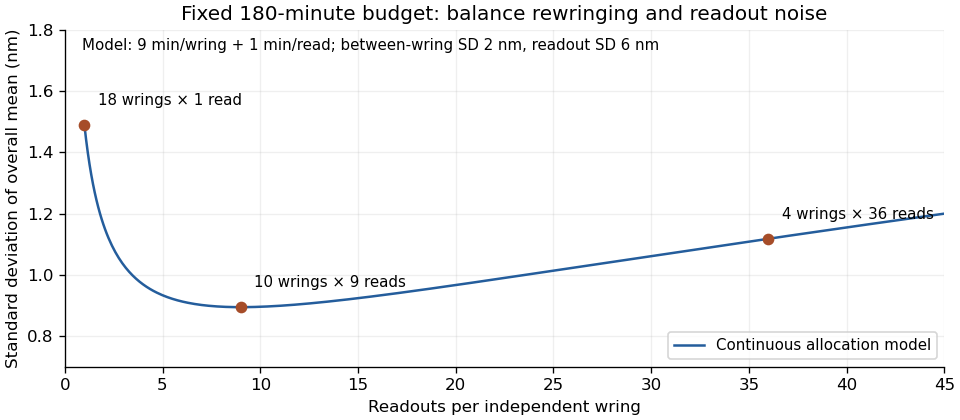
Original fixed-budget model comparing rewringing with repeated readout; all costs and variance components are stipulated
. Details. 
The variance components need pilot information. Wringing-allocation pilot uncertainty can change the preferred allocation, especially if a small pilot wrongly suggests negligible between-wring variation. Include enough independent preparations to assess that level rather than optimizing solely for an assumed mean variance.
The physical contact can also change with time, handling or surface damage. NIST documents dependence of wringing films on conditions and elapsed time.[ref] Drift, preparation trends and shared reference uncertainty require additional terms; they do not necessarily decrease by adding readings according to this independent-effects formula. State the objective and the constraints with the final design.
Wringing-allocation pilot uncertainty is uncertainty in the noise components used to choose how many gauge block contacts to prepare and how many readings to take per contact. The optimum in nested contact-study allocation depends on estimated between-contact and within-contact variability; a short pilot does not determine their ratio exactly.
For a balanced pilot with independent wrings and readings per wring, use the random-intercept linear mixed modelwith all random effects independent. The within-wring mean square has expected value ; the between-wring mean square has expected value . Thus method-of-moments planning estimates areTruncating a negative estimate is a boundary convention, not proof that true between-wring variance vanishes. The expectations follow by decomposing the independent within-wring residuals and wring means in this stated model.
An original pilot has , and . The estimates are nm and nm. If another short pilot gives with the same , truncation instead gives . Substituting that boundary value into the continuous planning rule drives the preferred readings per wring toward infinity, revealing a fragile design decision rather than an experimentally established absence of contact variability.
With independent normal residuals, has relative standard deviation , where . Five wrings with two readings each give and approximately 63% relative scatter in this variance estimate. The between-component estimate subtracts two noisy mean squares and can be still less stable. More readings of the same contact do not substitute for observing more independent contacts.
A useful planning sensitivity analysis holds readout standard deviation at a stipulated 6 nm while testing plausible from 1 to 4 nm. With preparation cost 9 minutes and reading cost 1 minute, the continuous optimumranges from 18 to 4.5 readings per wring. Under a 180-minute budget, feasible allocations give mean variances approximately when nm, but when nm. The best choice among these candidates changes with the pilot assumption; no one set of counts is universally optimal.
Cluster-resampled wringing allocation can retain the pilot's contact grouping when assessing planning sensitivity; treating all readings as independent destroys the nesting. Any resampling still inherits the pilot's limited contact population. Physically, record fresh preparation, waiting time and handling: NIST documents changes in wringing films with conditions and elapsed time.[ref] Drift and common reference errors require their own model terms rather than being silently absorbed into independent readout noise.
Cluster-resampled wringing allocation uses pilot contacts as the resampling units when assessing how uncertain wringing and readout variability affect a planned gauge block study. Readings from one prepared contact stay grouped. Resampling them as unrelated observations would remove the dependence that motivates nested contact-study allocation.
Write the pilot as vectors from independently prepared contacts. A cluster bootstrap draws of these vectors with replacement, copies every reading in each selected vector, recomputes the variance-component estimates and then reevaluates candidate allocations. For an original five-contact illustration, drawn indices copy contact2 twice and omit contact3. Each draw is a separate bootstrap occurrence; neither duplication nor omission creates a new physical contact. The empirical-with-replacement construction is the general bootstrap procedure, applied here to contact vectors.[ref]
Lecture 12: The Bootstrap. “The Bootstrap”, resampling and recomputing the statistic; “High level idea”, conditional empirical law
For a balanced random-intercept linear mixed model, each resample can yield planning estimatesWith preparation/read costs , a finite candidate has cost and modeled mean variance . Comparing candidates within each resample reveals how often the preferred allocation changes, instead of treating one pilot ratio as known exactly.
For an original180-minute budget with and minute, consider . With and , their mean variances are approximately0.6222,0.5556 and0.5778nm², favoring12 contacts with6 readings. Changing only the planning between-contact variance to1nm² gives0.4222,0.3056 and0.2778nm², favoring10 contacts with9 readings. A resampling distribution of planning inputs can therefore matter to the design decision.
The cost of flattening the data is visible analytically. Under the same model, the true mean variance is , while an independence calculation over all readings gives . Their ratio isusing intraclass correlation . For and , the variance ratio is2.5, a design effect that an independence-based analysis misses.
This nonparametric analysis inherits the limited empirical contact distribution and any boundary estimate . More bootstrap draws do not provide more independent wrings. Drift, shared standards or an unbalanced pilot need an appropriate model or resampling design. NIST documents physical wringing films and their dependence on preparation and elapsed time, which is why contact preparation belongs in the experimental record.[ref]
Articles by others on the same topic
There are currently no matching articles.