NIST trace-gas FTMW validation experiment
ID: nist-trace-gas-ftmw-validation-experiment

The NIST validation report used carbonyl sulfide in argon to illustrate the readout. A pulsed nozzle injected a molecular beam along a two-mirror cavity. Approximately excitation prepared quantum coherence; a receiver digitized the decaying electric field, then a Fourier transform produced spectral lines. Counterpropagating cavity waves produced a Doppler shift doublet; its midpoint represents one rest-frame transition.[ref]
The Validation of Fourier-Transform Microwave Spectroscopy for Trace-Gas Analysis. The Validation of Fourier-Transform Microwave Spectroscopy for Trace-Gas Analysis, printed pp. 25–26, Figures 2–3: coaxial apparatus, excitation and OCS readout; PDF pages 31–32
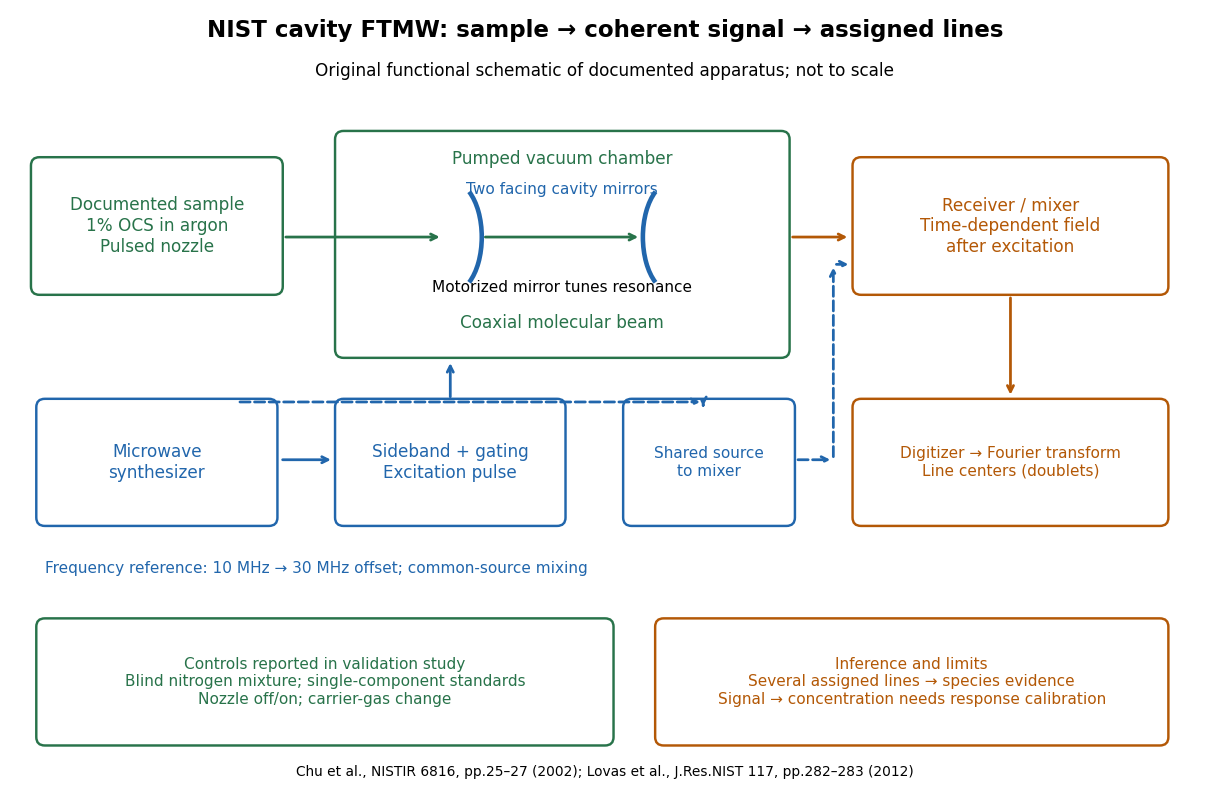
Original functional schematic of the NIST trace-gas FTMW validation experiment
. An original arrangement of the documented sample, cavity, excitation and readout functions; no published figure is copied. The frequency-reference branch summarizes the later portable electronics described in the NIST historical account. The sample fraction is a reported preparation, not a synthetic measured spectrum. Details.
The portable electronics used a common microwave source and a offset derived from a reference. Cavity tuning selects the accessible band; it does not independently calibrate the line's frequency. Absolute accuracy also requires a characterized reference and receiver offset.[ref]
Evolution of Microwave Spectroscopy at the National Bureau of Standards (NBS) and the National Institute of Standards and Technology (NIST) by F. J. Lovas and others. §5, printed pp. 282–283, Figure 20: source splitting, frequency reference, single-sideband modulation, mixer and digitizer
Reported controls included nozzle off/on, carrier-gas changes, and a blind nitrogen mixture. Assigned components were correctly identified. Single-component standards supplied preliminary concentration calibration; one standard per quantified component left response validation incomplete. Condensation and departure from thermal equilibrium in the nozzle were acknowledged limitations.[ref]
The Validation of Fourier-Transform Microwave Spectroscopy for Trace-Gas Analysis. printed pp. 26–27: nozzle/carrier comparison in Figure 6, blind mixture in Table II, one-standard calibration and nozzle-expansion limitations
The lesson is that rotational spectral line assignment and concentration inference answer different questions. Reproducible frequencies support molecular identity; converting signal size into concentration requires calibrated response under the same transfer and excitation conditions. The thermal absorption example above does not model a nozzle's nonequilibrium populations or the cavity's pulsed response.
New to topics? Read the docs here!