A molecular beam also includes a stream of chemical atoms, then called an atomic beam. An oven supplies particles; aligned slits restrict their directions, and a vacuum limits subsequent collisions. Narrowing the directions does not by itself make every particle's speed equal. This gives a useful separation of tasks: prepare a path, select or measure speed, apply an interaction, and read the resulting particle counts or deflection.
The advantage is unusually tangible. A magnetic field can separate spin components in the Stern-Gerlach experiment; even gravity can sort a beam by flight time. The effusive beam speed distribution explains which particles leave the source, while gravity deflection of an atomic beam explains how that distribution becomes a pattern on a detector.
In 1911, Louis Dunoyer de Segonzac formed a sodium beam in vacuum and collected a deposit on a surface cooled with liquid air. Its shape agreed with straight paths through the slits.[ref]
The Method of Molecular Rays by Otto Stern. The method of molecular rays, lecture 12 December 1946, pp. 8–9: Dunoyer's sodium beam, collimation and cooled collector
A deposit tests the geometry of the surviving paths. A clock or a calibrated deflection is needed to turn their travel into a speed measurement.Which speed distribution does an arrival counter measure? Suppose an equilibrium, nonrelativistic ideal gas escapes by effusion through a thin opening into vacuum. The opening is small compared with the mean free path; the reservoir remains at temperature . Let denote its normalized Maxwell speed distribution, with mass and :At a given direction toward the opening, the number crossing per unit time is proportional to the normal component . Integrating over a fixed accepted cone contributes an angular factor independent of . Thus the normalized probability density function for speeds among arriving particles isIts integral is one because . The reservoir mode is ; the arrival mode is . Faster particles get more opportunities to cross the opening. This is a selection effect, not heating after emission.
Specify the observable before applying the formula. An instantaneous count in a fixed segment of the beam weights the arrival flux by the time spent there, proportional to ; in this ideal model its normalized speed law returns to . A detector's speed-dependent efficiency, source collisions or a velocity selector changes the arriving law again. Counting arrivals and counting particles currently present are different measurements.
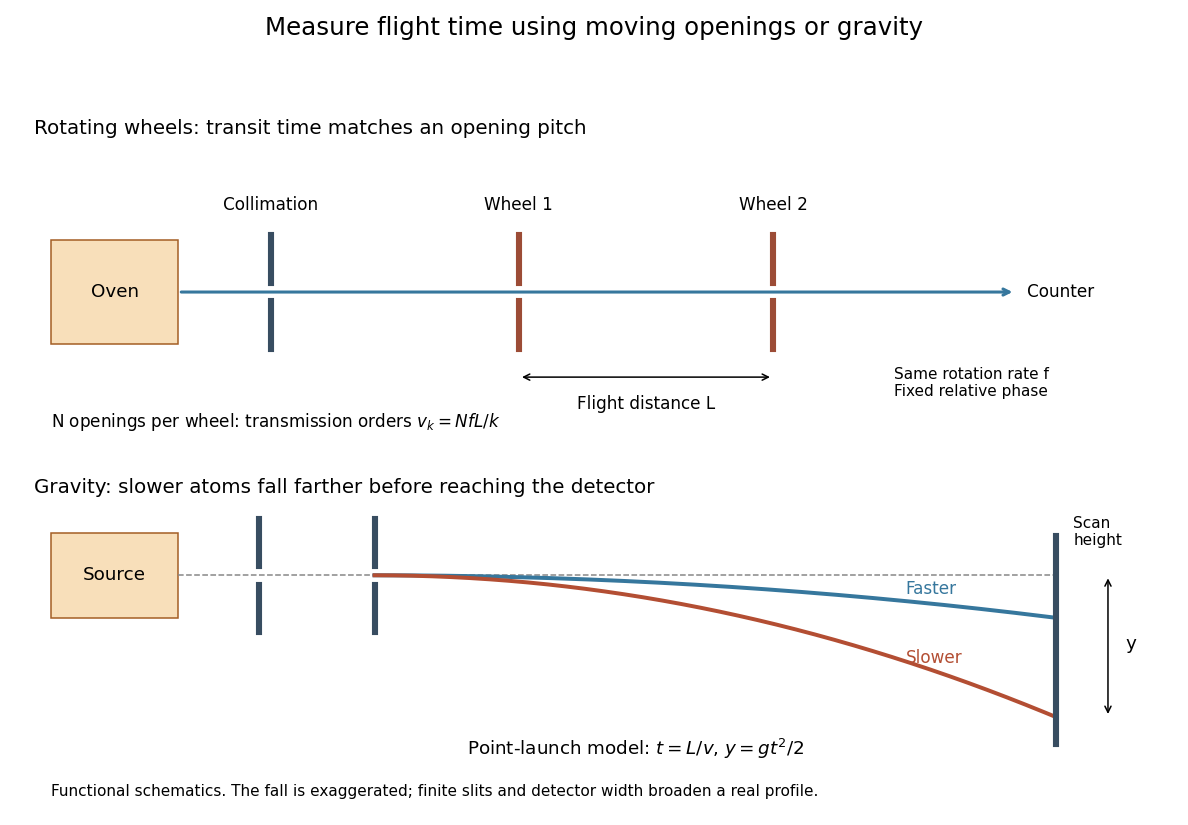
Otto Stern's lecture describes two co-rotating toothed wheels: transit between them must match an advance between openings. He explicitly distinguishes this method from the first historical speed measurement.[ref]
The Method of Molecular Rays by Otto Stern. The method of molecular rays, lecture 12 December 1946, p. 9: rotating-wheel timing, transmission and limited accuracy
For an idealized example, let aligned wheels have equally spaced openings, separation , and rotation rate in revolutions per second. A particle with constant longitudinal speed takes between them. The second wheel advances through revolutions; transmission peaks when that advance is an integer number of opening pitches:With chosen , and , the first two orders select and . A second transmission maximum therefore need not represent a second source temperature. Finite opening widths admit speed intervals around each order, and an additional measurement is needed to distinguish orders. The ideal expression assumes negligible acceleration and constant rotation rate during a flight, with a fixed relative phase between the wheels.
Immanuel Estermann, O. C. Simpson and Otto Stern used gravitational deflection to measure atomic speeds. Stern describes scanning a hot-wire surface ionization detector through a cesium beam and recording ion electric current.[ref]
The Method of Molecular Rays by Otto Stern. The method of molecular rays, lecture 12 December 1946, pp. 9–11: collaborators, falling beam and ion-current readout
Their 1947 paper reports potassium and cesium beams; a deficit of slow arrivals increased with oven pressure, supporting a source-slit collision explanation.[ref]The Free Fall of Atoms and the Measurement of the Velocity Distribution in a Molecular Beam of Cesium Atoms by Immanuel Estermann, Oliver Cecil Simpson, and Otto Stern. Estermann, Simpson and Stern, Physical Review 71 (15 February 1947), p. 238, abstract: gravity deflection, modified Maxwellian distribution and pressure-dependent slow-atom deficit
First consider an original point-launch model, with horizontal speed , zero initial vertical velocity, flight distance , and uniform gravitational acceleration . Downward displacement follows from flight time :Slow particles fall farther. However, a detector scan counts arrivals per interval of height, not per interval of speed. Change of variables for probability densities supplies the Jacobian determinant:Here denotes the effusive beam speed distribution; the unadorned constant in denotes gravitational acceleration. The integral of is one: substituting reduces it to . Its mode is . Simply mapping the most probable arrival speed into a fall distance instead gives . The peaks differ because equal height bins cover unequal speed intervals.
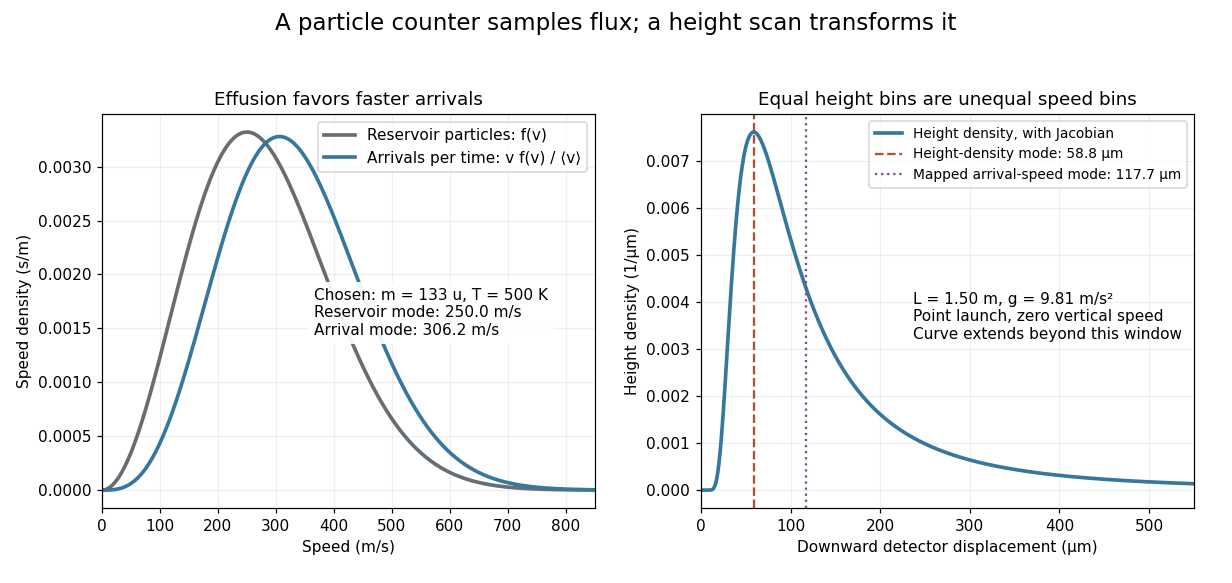
Effusion changes the arrival speed distribution, and a detector-height scan requires another Jacobian determinant
. Original calculated distributions with chosen , , and . These are not historical measurements. Details.For those chosen parameters, , so the detector-height probability density peaks near . A detector covering only accepts the fractionAt this is about , even before allowing for imperfect detection. Discarding the remainder changes the observed normalization.
Real slits transmit a range of launch heights and vertical velocities. Their geometrical response must be combined with the gravitational deflection and detector width; the point-launch formula is not an exact reduction of the historical apparatus. In the point-launch model, an initial vertical velocity would add to . Source collisions, detector efficiency and alignment can also distort a profile. Varying oven pressure helps distinguish such source losses from an incorrect thermal distribution; inferring a source temperature from the peak alone ignores both selection and the detector's coordinate transformation.
A directed stream of chemical atoms, such as the neutral silver stream in the Stern-Gerlach experiment.
A surface ionization detector detects a neutral atomic beam by converting incident chemical atoms into ions on a hot surface. For suitable alkali metals, a heated tungsten surface can favor loss of an electron: the competing surface work function and atomic ionization energy make the efficiency strongly dependent on species, surface condition and temperature. An electric field then collects the resulting ions, producing an electric current or a count after amplification. A response therefore requires an efficiency measurement calibration; it is not automatically equal to the incident particle flux.
A 2002 imaging experiment used a tungsten-coated heated ribbon followed by a microchannel plate detector and a phosphor screen. It recorded where the arriving neutral chemical atoms struck, rather than just their total rate. The reported approximately spatial resolution and roughly detection efficiency belong to that apparatus and its conditions, rather than to every surface ionization detector.[ref]
A molecular beam skimmer is a small aperture, commonly at the tip of a cone, that transmits the central part of an expanding molecular beam into a downstream chamber. It separates source and measurement regions so that differential pumping can maintain a lower background pressure after the source. Its geometry selects directions; that selection alone does not give all transmitted molecules the same speed.
The surface also perturbs the beam. At high source number density, particles reflected from the skimmer walls can collide with the incoming flow and create shock waves, reducing and heating the transmitted beam. A 2017 experiment cooled the skimmer and measured a beam-flux increase of about eightfold under its tested conditions. A pulsed plasma glow made the disturbed flow visible; cooling reduced reflected momentum and, at lower temperatures, promoted adsorption. This tests why a narrower geometric opening is not a complete model of a real skimmer.[ref]
Molecular beam brightening by shock-wave suppression by Yair Segev and others. Fig. 1 and Results and Discussion: wall interference, discharge imaging, cooling and measured flux enhancement
Articles by others on the same topic

Molecular beams are cool because they create a one dimensional flow of molecules, which makes it easier to observe certain single-molecule effects, as it removes the multi-particle issues from experiments.
Key molecular beam experiments include:
- Stern-Gerlach experiment, which confirmed the existence of spin
- Rabi's NMR experiment, which confirmed the existence of nuclear spin



A molecular beam refers to a directed flow of particles, typically molecules or atoms, that are produced in a vacuum environment. This technique is widely used in various fields of physics, chemistry, and materials science for studying molecular interactions, reactions, and properties. In a molecular beam apparatus (MBA), molecules are generated in a gas-phase source, often using methods such as effusive flow from a small nozzle or laser ablation.