Nonunique optimal prefix code
ID: nonunique-optimal-prefix-code

An optimal prefix code can be nonunique in several different senses. Exchanging the labels on the outgoing edges of an internal vertex changes codewords while preserving every symbol's codeword length, the code tree shape, and expected codeword length. This freedom exists even with strictly unequal probabilities. Exchanging equal-probability symbols between leaves also preserves expected codeword length; if their leaf depths in a code tree differ, their individual codeword lengths change, though the set of leaf depths does not. For example, three equiprobable symbols have optimal codeword lengths : any of the three can receive the one-bit codeword.[ref]
A Method for the Construction of Minimum-Redundancy Codes by David A. Huffman. p. 1099, Derived Coding Requirements: equal-probability messages may have unequal lengths and may exchange codes without changing the mean
Ties between weights of entire subtrees during Huffman coding can go further and change the code tree shape and its collection of codeword lengths. Take and first merge , creating weight . Next, of weight can merge either with or with the subtree, both of weight . The two resulting prefix codes areFor the second prefix code, bits. Both merge sequences add weights , whose sum is . Enumerating the full binary trees with four leaves also proves optimality independently: costs , while the least cost of is again . The two code trees cannot be obtained from each other merely by relabelling leaves or exchanging edge labels: their collections of leaf depths in a code tree differ.
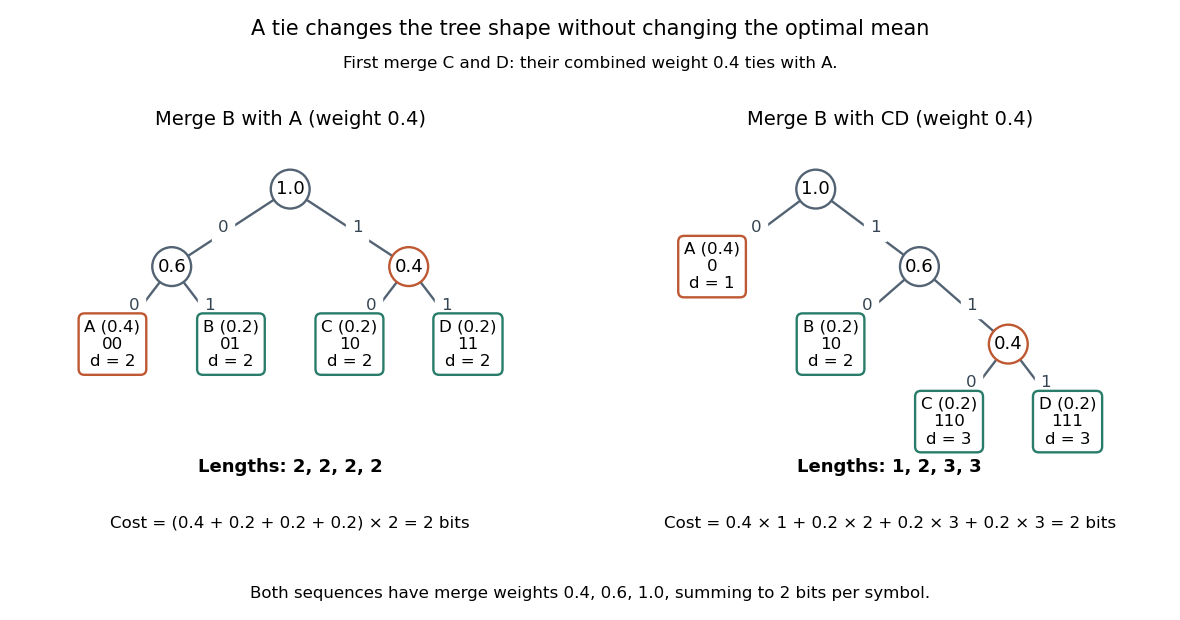
A tie between a symbol and a merged subtree gives two optimal prefix trees, with depths 2,2,2,2 and 1,2,3,3
. Details. 
The quantifier in the Huffman sibling property is visible here too. Choose as two least-probability symbols. In the displayed balanced optimal prefix code, they are not sibling leaves in a code tree. Exchanging , which have equal probabilities, produces another balanced optimal prefix code in which are deepest sibling leaves in a code tree. Thus the proof supplies an optimal representative with the chosen pair together. It does not force that labelling on every optimum. An implementation can make its tie choices and edge assignments deterministic when encoder and decoder need to reproduce the same codewords; optimal mean length alone does not specify them.
New to topics? Read the docs here!