
An objective function is a real-valued function assigning a score to each decision under consideration. An optimization problem seeks a feasible solution maximizing or minimizing this score. The optimizing decision and its score are different objects: in the budget constraint example, the decision is and the optimal value is .
Choosing an objective function expresses what matters. With and , maximizing makes every feasible point equally good; maximizing selects ; maximizing rewards balance. If are side lengths, is a rectangle's area, and the budget constraint fixes its perimeter at . The same mathematics then says that a square encloses the largest area among these rectangles.
For the product objective function, the positive level sets are hyperbolas. Each collects decisions with identical scores. The highest attainable level set touches the feasible set at ; higher ones miss it entirely.
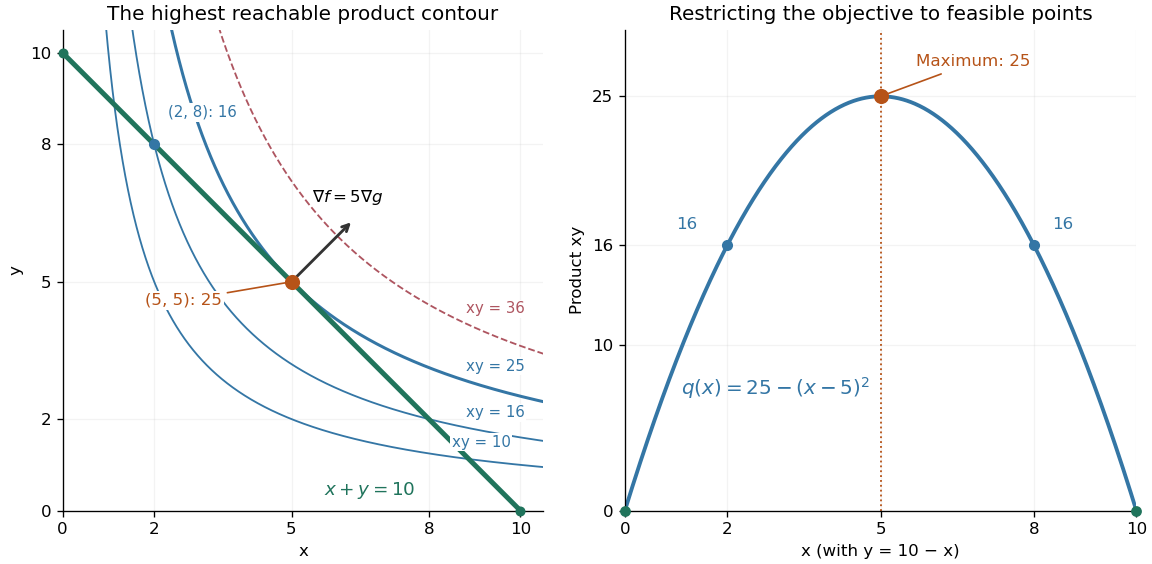

The product is neither a convex function nor a concave function on the positive quadrant: along it is , while along it is . Yet its restriction to this feasible set is a strictly concave function. Thus the geometry of the allowed decisions can make an otherwise nonconcave maximization problem tractable. Replacing by always converts a maximization problem into an equivalent minimization problem.
// Target: mathematical-optimization.bigb
New to topics? Read the docs here!