
Order tracking follows vibration or other signal components according to their ratio to a reference shaft's rotational frequency. That ratio is the rotational order:where is speed in revolutions per minute and are measured in hertz. A component at three cycles per reference revolution has order 3 even while its ordinary frequency changes. The reference shaft must be specified; changing the reference changes the order value.[ref]
Order Analysis of a Vibration Signal in MATLAB documentation. Introduction, order definition and reference-speed ratios
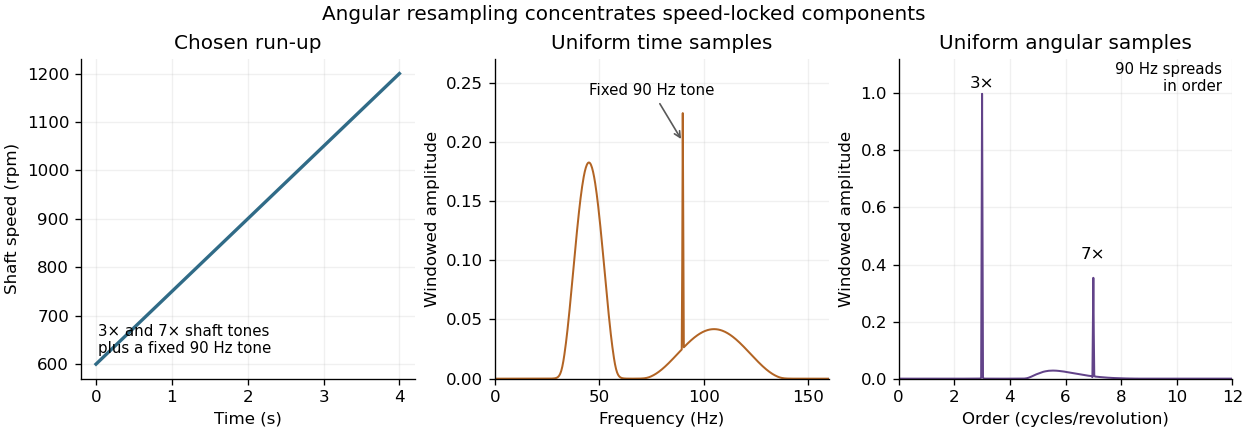
For an original example, a shaft accelerates from 600 to 1200 revolutions per minute. Its third-order component sweeps from 30 to 60 hertz, while its seventh-order component sweeps from 70 to 140 hertz. A Fourier transform over the entire time record spreads those components over frequency. An unrelated fixed 90-hertz tone instead retains its frequency but changes from order 9 to order 4.5.
Angular resampling expresses the record on a uniform shaft-angle grid. A speed-locked component then becomes , with fixed angular periodicity. An order spectrum or order-versus-speed map can separate that structure from a frequency-domain smear. MathWorks demonstrates this distinction with explicitly simulated helicopter-vibration data.[ref]
Order Analysis of a Vibration Signal in MATLAB documentation. Visualize Data Using an RPM-Order Map; example-data introduction

In an apparatus, an accelerometer can record housing motion while a tachometer or rotary encoder records the reference. Tracking an order's amplitude and phase over a run-up can reveal where the machine's response grows, but a large amplitude need not identify the forcing mechanism by itself. Mechanical resonance, load changes and sensor placement can also change the response.
Time-synchronous averaging is related but answers a different question: it estimates a waveform repeatable over the chosen reference period. Order tracking can retain amplitude variation over speed and inspect selected components. Record speed-estimation assumptions, angular resolution and amplitude normalization with either analysis.
New to topics? Read the docs here!