Order tracking follows vibration or other signal components according to their ratio to a reference shaft's rotational frequency. That ratio is the rotational order:where is speed in revolutions per minute and are measured in hertz. A component at three cycles per reference revolution has order 3 even while its ordinary frequency changes. The reference shaft must be specified; changing the reference changes the order value.[ref]
Order Analysis of a Vibration Signal in MATLAB documentation. Introduction, order definition and reference-speed ratios
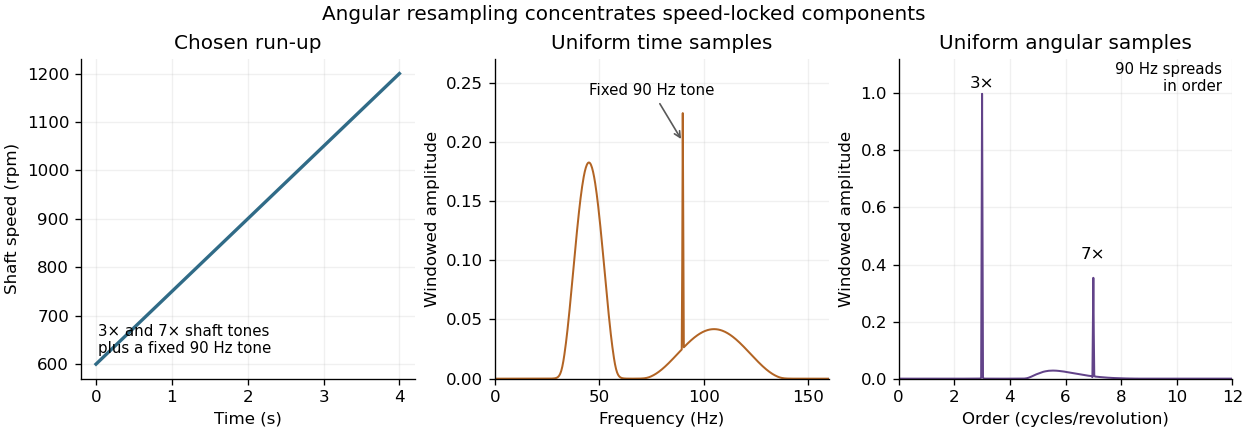
For an original example, a shaft accelerates from 600 to 1200 revolutions per minute. Its third-order component sweeps from 30 to 60 hertz, while its seventh-order component sweeps from 70 to 140 hertz. A Fourier transform over the entire time record spreads those components over frequency. An unrelated fixed 90-hertz tone instead retains its frequency but changes from order 9 to order 4.5.
Angular resampling expresses the record on a uniform shaft-angle grid. A speed-locked component then becomes , with fixed angular periodicity. An order spectrum or order-versus-speed map can separate that structure from a frequency-domain smear. MathWorks demonstrates this distinction with explicitly simulated helicopter-vibration data.[ref]
Order Analysis of a Vibration Signal in MATLAB documentation. Visualize Data Using an RPM-Order Map; example-data introduction

In an apparatus, an accelerometer can record housing motion while a tachometer or rotary encoder records the reference. Tracking an order's amplitude and phase over a run-up can reveal where the machine's response grows, but a large amplitude need not identify the forcing mechanism by itself. Mechanical resonance, load changes and sensor placement can also change the response.
Time-synchronous averaging is related but answers a different question: it estimates a waveform repeatable over the chosen reference period. Order tracking can retain amplitude variation over speed and inspect selected components. Record speed-estimation assumptions, angular resolution and amplitude normalization with either analysis.
A rotational order expresses a signal’s frequency relative to a specified reference shaft’s rotational frequency:Thus means one oscillation per reference revolution and means one oscillation per two reference revolutions. A rotational order is dimensionless and need not be an integer. It is especially useful when a machine changes speed: a shaft-synchronous feature can keep the same rotational order while moving through many frequencies in an ordinary frequency spectrum.[ref]
Order Analysis of a Vibration Signal in MATLAB documentation. Introduction and Create RPM-Order Map: rotational-frequency multiples and constant-phase resampling; the helicopter data are simulated
The reference is essential. Suppose shaft A turns at and shaft B at . The same signal has rotational order relative to A and relative to B. Changing the reference has changed the dimensionless label, not the measured vibration. Likewise, a 24-tooth gear turning at has a gear mesh frequency of . Its mating 8-tooth gear turns at , giving the same gear mesh frequency but rotational orders and relative to the two shafts.
For a component with unwrapped phase and reference angle , the instantaneous version iswhere the reference angular velocity is nonzero and both angles use the same units. A constant rotational order gives . This explains why angular resampling makes a speed-following component periodic as a function of shaft angle. A vibration fixed at instead changes from rotational order to when the reference shaft accelerates from to .
An order tracking measurement therefore pairs a vibration sensor, such as an accelerometer, with a shaft-angle or speed reference, such as a tachometer. An order peak identifies a speed relationship; it does not by itself establish which part is damaged. A resonance can greatly change the amplitude as speed changes even when the excitation’s rotational order stays fixed.
Angular resampling converts a signal recorded at known times into values at equally spaced shaft angles. It is a change of sampling coordinate, used in order tracking and time-synchronous averaging. The signal must be accompanied by a reliable monotonic angle history over the interval being transformed.[ref]
Order Analysis of a Vibration Signal in MATLAB documentation. RPM-order-map method, resampling at constant phase increments
For positive speed in revolutions per minute, an unwrapped reference angle isChoose , find times satisfying , and estimate by interpolation from the original samples. Uniform time samples generally produce nonuniform angle samples; evaluating at the new is the resampling step. A modulo- angle must first be unwrapped, rather than inverted as if each revolution restarted time.
An original acceleration model has revolutions per minute, with in seconds. Taking givesSampling every quarter revolution requires , henceThe first quarter-turn intervals are about 0.02470 and 0.02411 seconds: angular spacing stays fixed while time spacing decreases. A third-order sinusoid becomes a fixed sinusoid of three cycles per revolution on the resampled coordinate.
With equally spaced samples per revolution, the angular Nyquist limit is cycles per revolution. Thus representing a maximum order requires more than angular samples per turn, with practical margin and appropriate filtering. This does not repair aliasing already present in the original time record. Its sampling rate, anti-aliasing filter and the fastest physical signal frequency also matter.
A once-per-revolution tachometer constrains completed turns but does not directly measure every speed fluctuation within a turn. Inferring the intermediate angle introduces a model; a higher-resolution rotary encoder can supply more information. Stops, reversals, missing pulses and timing offsets need explicit handling. Resampling an uncertain angle history can produce a sharp-looking spectrum without making that angle history accurate.
Articles by others on the same topic
There are currently no matching articles.