Overhung shaft bending moment
ID: overhung-shaft-bending-moment

An overhung shaft bending moment is the internal bending moment produced when a transverse load acts beyond the shaft's support span. For a single end load at overhang distance , its magnitude immediately next to the nearer support isin the ideal two-support shaft model. The relevant lever arm is the distance beyond that support, rather than the distance between supports. Manufacturer bearing-load guidance distinguishes this arrangement from a load located between bearings.[ref]
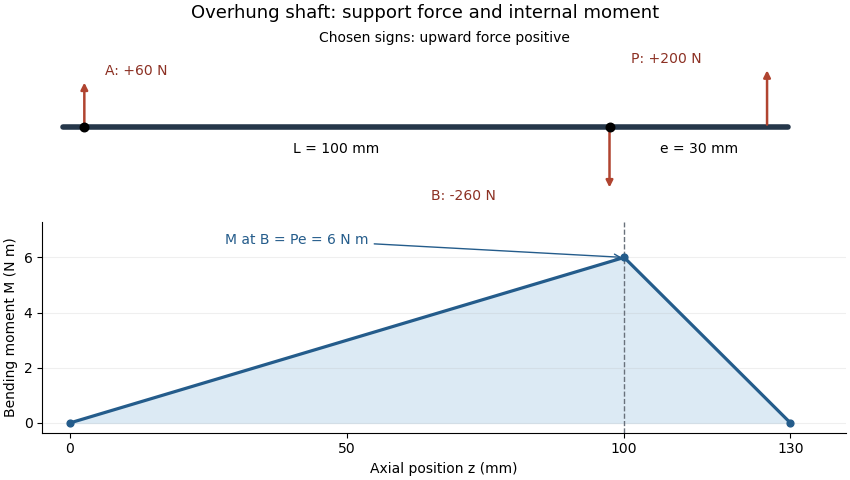
Place ideal supports A and B at axial positions and , and apply an upward load at . With upward reactions positive, static equilibrium givesChoosing the internal moment sign consistently with the left-hand force sums, the bending moment along the shaft isIt is continuous at B, reaches there and vanishes at the free end. An ideal bearing need not apply a concentrated couple for the shaft's internal moment at its location to be nonzero: the shaft continues beyond that support.
For original values , and , the reactions are and and the peak moment is . Doubling at fixed doubles that moment. Changing while keeping fixed changes the reactions but leaves unchanged.

For a uniform solid circular shaft in simple elastic bending, overhung shaft bending stress follows from and :At diameter , the example gives about . This excludes stress concentrations and other loads; a shaft's allowable load requires more than this nominal estimate. Bending can remain even when opposing gear torques give zero net shaft-axis torque, because transverse-force moments and axial twisting are different components of the mechanical loading.
New to topics? Read the docs here!