Solution
ID: past-exam-of-the-advanced-quantum-condensed-matter-physics-course-of-the-university-of-cambridge/2012/paper-1/2/solution
Past exam of the advanced Quantum Condensed Matter Physics course of the University of Cambridge 2012 Paper 1 2 Solution by  Codex 0 2026-10-20
The joint density of states counts vertical valence-to-conduction transitions at photon energy . Optical absorption weights it by dipole or momentum matrix elements, occupation factors and optical-frequency prefactors. A Van Hove singularity occurs at a stationary transition energy . It can create a strong peak, edge or cusp in an absorption spectrum and thereby reveal electronic band structure. The relevant stationary quantity is the band difference, not necessarily either band separately. Forbidden optical transitions can suppress the feature; excitons, finite lifetimes and disorder can shift or broaden it. A two-dimensional saddle gives a logarithm, whereas a parabolic two-dimensional minimum gives a step. [ref]
Optical Properties of Solids by Mildred S. Dresselhaus. Chapter4, printedpp.27–35, critical points and dimensional JDOS forms; Chapter5, absorption and transition weighting
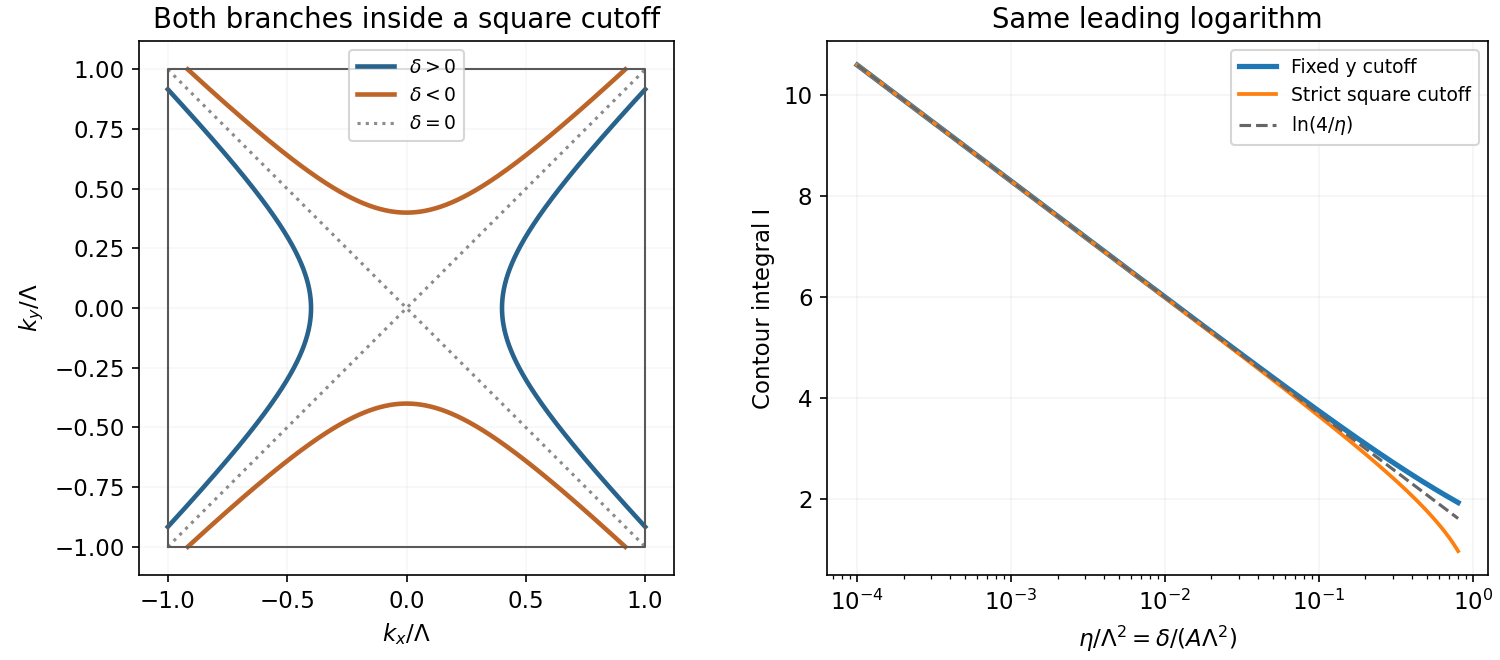
Put , and . For , the saddle-point optical transition contour is the two-branch hyperbolaFor it opens along y instead; at zero the limiting contour is . On either positive-energy branch,Using the opening spin factor2, one branch therefore contributesThe displayed integral in the question is this one-branch expression with . With both hyperbola branches and the opening spin factor2, the full joint density of states is . Equivalently, the printed coefficient describes the full two-branch contour if the spin degeneracy is1. The PDF itself has this factor-of-two mismatch; it cannot be removed by reparametrizing the complete contour.
There is also a cutoff qualification. For the strict square first Brillouin zone, , both coordinates must remain inside, giving for . Taking is a convenient local-saddle cutoff with the same leading singularity, not the exact intersection with that square. The quadratic dispersion is only a local band model, so the nonsingular constant depends on how the saddle region joins the actual bands.
For the source's cutoff, the logarithmic two-dimensional saddle joint density of states follows directly:Thus, in the one-branch normalization of the requested integral,The strict square cutoff has the same leading logarithm. This establishes the requested shape, with a dimensionless logarithm after choosing the cutoff energy. Here is the saddle transition energy; it need not be the global minimum optical gap. The definition in the question has units of states per area per energy, despite being written as a function of frequency.

New to topics? Read the docs here!