
For a smooth function on an open set , a critical point is an input where the gradient vanishes: . Equivalently, every first partial derivative is zero. Such a critical point is a stationary point; in one variable the condition is .
There is a broader convention in elementary one-variable calculus: a "critical number" is an interior input where the derivative is zero or does not exist, provided the function itself is defined there. Thus a corner can be a critical number without being a stationary point. Here the smooth meaning of critical point is used unless the broader convention is explicitly stated. [ref]
https://openstax.org/books/calculus-volume-1/pages/4-3-maxima-and-minima. Gilbert Strang and Edwin Herman, OpenStax Calculus Volume 1, §4.3: critical numbers
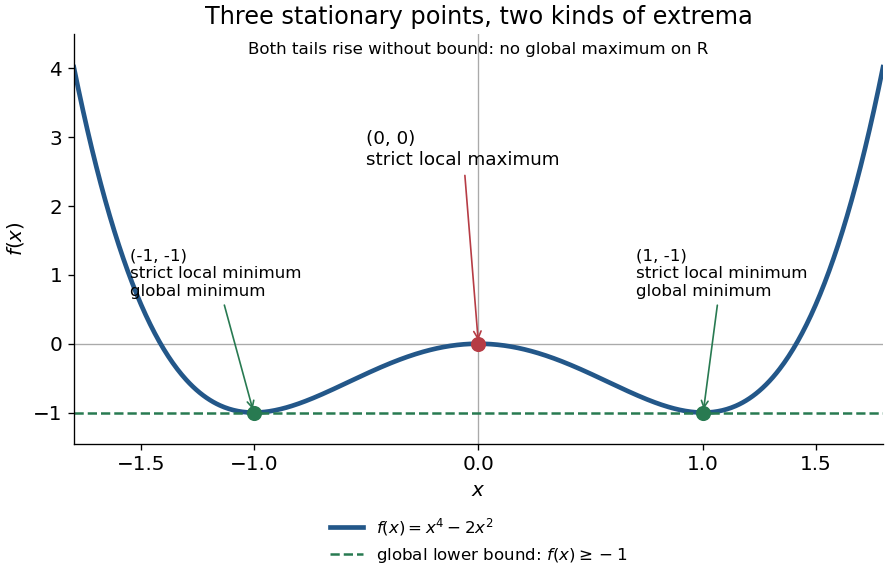
For the polynomial on the real line,The stationary points at are strict local minima and attain the global minimum; the stationary point at is a strict local maximum. One can check the local classifications from , which is positive at and negative at zero. The identity proves the global minimum directly. Since as , there is no global maximum on .
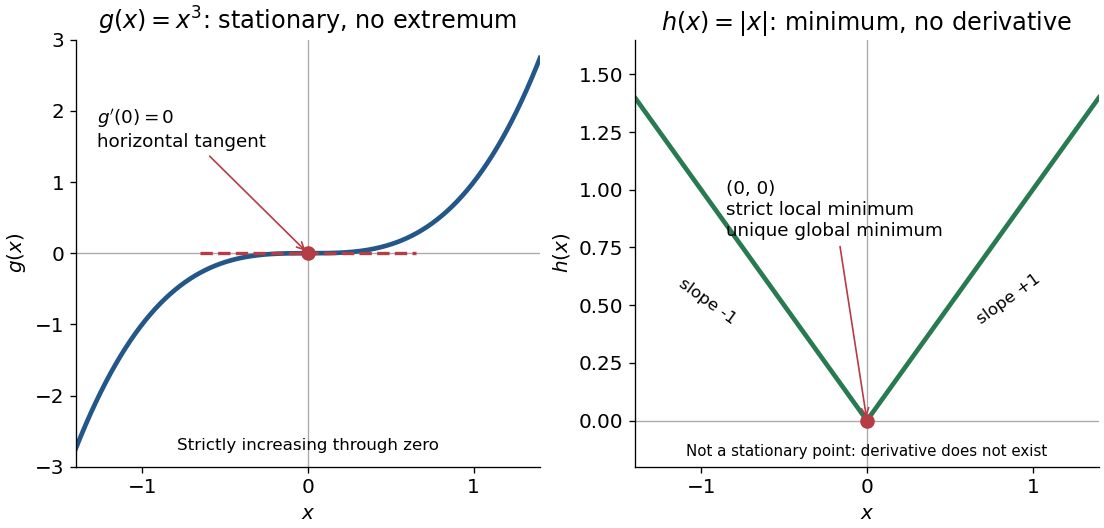
A zero derivative alone does not guarantee an extremum. The polynomial has but is strictly increasing through zero: every neighbourhood of zero contains both positive and negative values, so zero is neither a local minimum nor a local maximum. Conversely, the absolute value function has a strict local minimum and a unique global minimum at zero, but its left and right derivatives are and . It is not differentiable there, so zero is a critical number under the broader convention and is not a stationary point.


The usefulness of critical points is that they reduce the search for smooth interior extrema to equations. Every local minimum or local maximum of a differentiable function at an interior point has zero gradient; this condition is necessary, and shows that it is not sufficient. The striking feature is that all the first directional derivatives must vanish together, even though the surrounding values can form a valley, a peak, or a saddle point of a scalar function. [ref]
https://www.ocw.mit.edu/ans7870/18/18.013a/textbook/HTML/chapter14/section01.html. Daniel Kleitman, MIT Calculus with Applications, §14.1: necessary conditions for an interior extremum
Proof outline: at an interior local minimum in one variable, the difference quotient is nonnegative for small and nonpositive for small . If the derivative exists, the two sides have the same limit, forcing . Reverse the inequalities for a local maximum. In several variables, apply this argument along each coordinate line to obtain zero partial derivatives and hence zero gradient. At a domain boundary, both directions may not be available: on attains its global minimum at zero although for its smooth extension.
New to topics? Read the docs here!