Solution
ID: past-exam-of-the-advanced-quantum-physics-course-of-the-university-of-cambridge/2012/paper-1/2/a/solution
Past exam of the advanced quantum physics course of the University of Cambridge 2012 Paper 1 2 a Solution by  Codex 0 2026-10-20
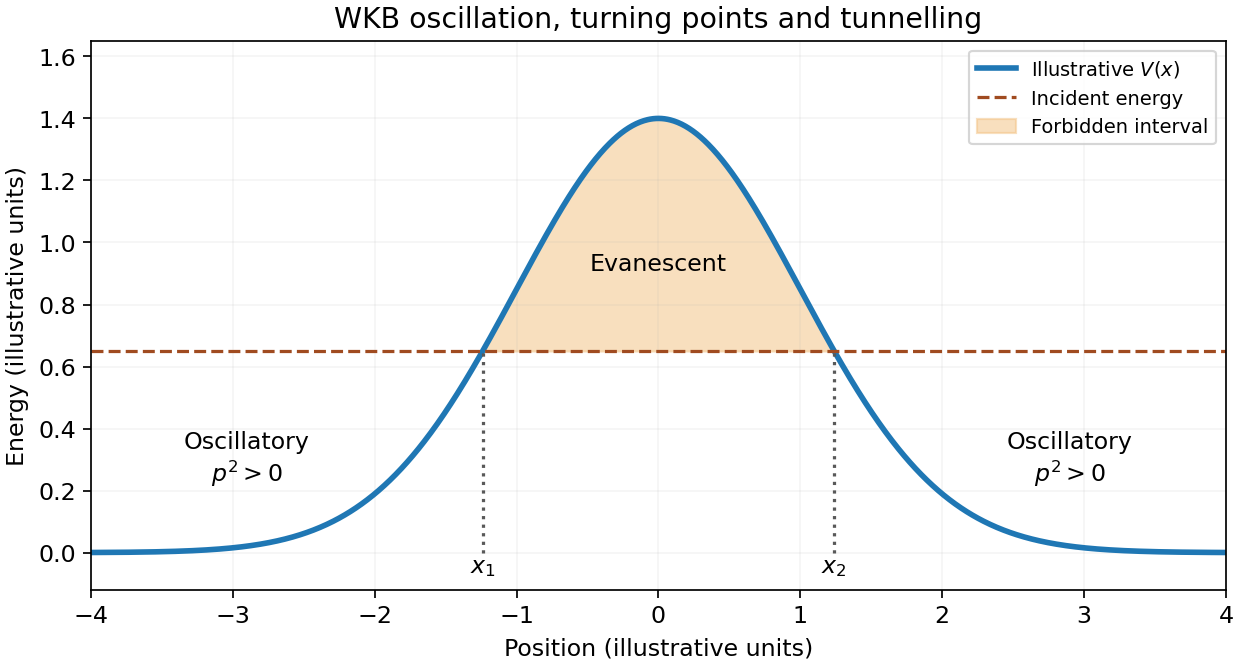
The WKB approximation, also called JWKB, describes a short local de Broglie wavelength in a slowly varying potential energy. For in a classically allowed region, its two local waves areThe phase follows the classical momentum; its amplitude varies to conserve probability current. In a forbidden region, putting gives , with boundary conditions selecting the physical combination.
The WKB validity condition is , with the analogous condition on . It fails at a turning point where . For a simple turning point, locally linearizing V yields an Airy function; matching fixes the relative amplitudes and a phase. Two such turning points give the two-turning-point WKB quantization conditionFor an opaque barrier, the WKB tunnelling exponent instead givesThe factor two distinguishes probability from amplitude. Matching determines the prefactor; the exponential alone is not accurate near the barrier top. These formulas connect bound state energy eigenvalues and quantum tunnelling to classical actions. [ref]
Topics in Quantum Mechanics by David Tong. §2.2, printed pp.37–49, semiclassical expansion, Airy matching and tunnelling

New to topics? Read the docs here!