Solution
ID: past-exam-of-the-advanced-quantum-physics-course-of-the-university-of-cambridge/2015/paper-1/4/solution
Past exam of the advanced quantum physics course of the University of Cambridge 2015 Paper 1 4 Solution by  Codex 0 2026-10-20
Insert the interaction-picture expansion into the Schrödinger equation. The phases multiplying the basis states already solve the unperturbed evolution, leavingHermiticity requires , not unless the coupling is real. Since the diagonal matrix elements vanish and , expanding the cosine givesThe conjugate pair of couplings conserves . Near resonance, the difference frequency is slow while the sum frequency is approximately . Rapid terms alternate sign before an appreciable slow transfer accumulates. The rotating-wave approximation retains the slow terms when ; resonance alone is insufficient for a strong drive. Counter-rotating corrections include small shifts of the resonance and need not remain negligible at arbitrary strength or arbitrarily long times.
For the spin preparation, use and . Choose and to fix helicity, with , and . The initial is the lower state. For negative , reverse the RF rotation sense; pulse areas use , and signed Larmor precession determines the corresponding phase adjustment.
A circularly rotating magnetic drive uses two transverse fields in quadrature during :With , their interaction Hamiltonian is exactly constant,The minus sign in the second RF component selects co-rotation for the specified positive gyromagnetic ratio. Exponentiating this Pauli matrix givesThe laboratory phase of a resonant spin pulse includes free precession. Returning to the laboratory frame and removing a common phase,Unlike a linearly polarized RF field, this exactly co-rotating field has no counter-rotating component. A single linearly polarized field gives the same slow rotation in the weak-drive rotating-wave approximation with . For the circular field above, . Keeping these amplitude conventions distinct avoids a factor-of-two pulse-duration error.
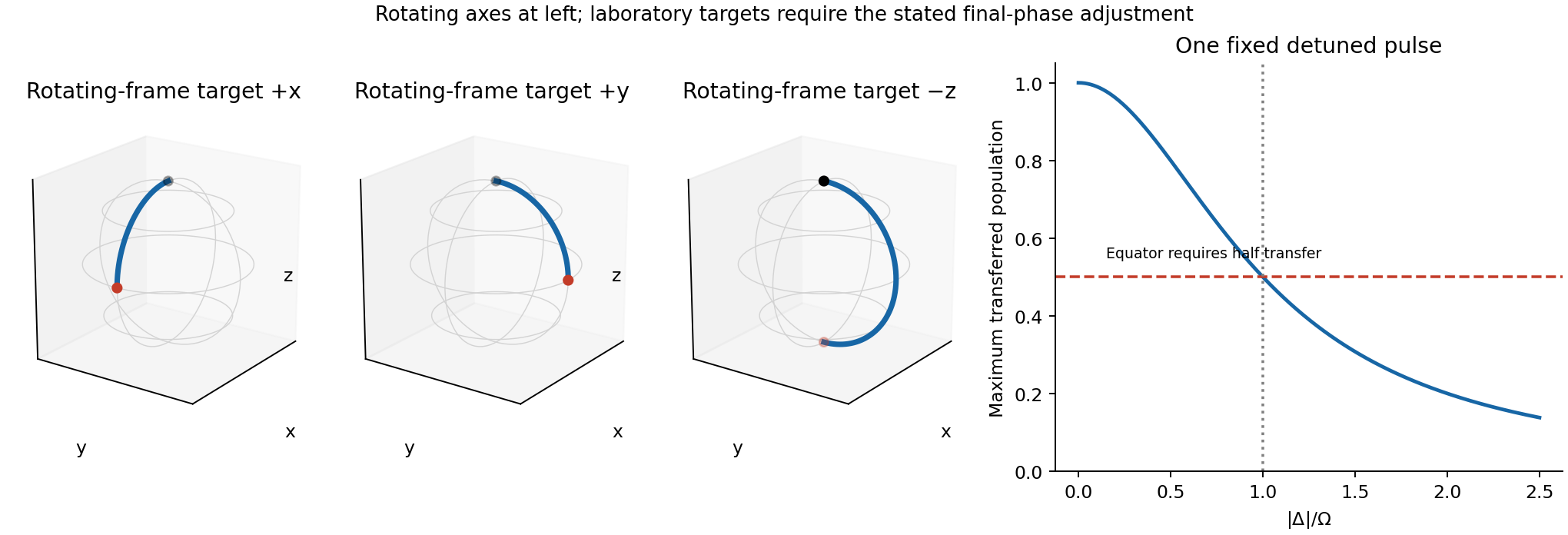

For a single harmonic pulse detuned by , the effective rotating-frame field tilts out of the transverse plane. Its rotation rate becomes , and its maximum population transfer is . Exact inversion to is impossible with one fixed nonzero-detuning pulse. Half transfer, needed for a transverse eigenstate, gives the equatorial reachability of a detuned spin pulse criterion . With that condition, changing the duration and RF phase can still prepare or at the chosen laboratory stopping time. The mere statement does not ensure this condition, because the drive can be much weaker than either frequency. If , neither transverse target is reached by that single pulse. These restrictions concern fixed-frequency, fixed-amplitude single-pulse control; retuning, chirping or phase-controlled composite pulses change the available controls and can remove the restriction. No dissipative spin relaxation is included in this coherent two-state model.
New to topics? Read the docs here!