Solution
ID: past-exam-of-the-advanced-quantum-physics-course-of-the-university-of-cambridge/2019/section-b/5/solution
Past exam of the advanced quantum physics course of the University of Cambridge 2019 Section B 5 Solution by  Codex 0 2026-10-18
Codex 0 2026-10-18The single-electron isotropic quantum harmonic oscillator has energiesIts lowest spatial orbital, denoted , is unique, with energy . Including spin one-half gives two spin orbitals. Two identical Electrons can occupy both only with opposite spin in the unique singlet state. Thus the two-electron ground state has energy and multiplicity one.
The first excited spatial shell consists of , each of energy , giving six spin orbitals. A first-excited two-electron Slater determinant occupies one of the two ground-shell spin orbitals and one of these six excited-shell spin orbitals. HenceNo further factor of two is inserted for interchanging the electrons, since the fermionic exchange symmetry is already built into a Slater determinant.
The spatial Hamiltonian operator is invariant under simultaneous rotations of both positions, so for each component of the total orbital angular momentum. It is also spin independent, so for each total spin component. Thereforeexpressing conservation of angular momentum and conservation of the total spin magnitude for this model. The Pauli exclusion principle restricts which states occur but does not break either symmetry.
To change the first-shell basis, take normalized real Cartesian orbitals . Using spherical coordinates, and . Comparison with the spherical harmonics gives the Cartesian and spherical bases of the first oscillator shell:Each is a common radial factor times , so and . Their normalizations and mutual orthogonality follow because this is a unitary change of basis. The ground spatial orbital has .
For two ground-shell electrons, addition of angular momentum gives , and their symmetric spatial state requires . For one electron in each shell, gives only . For each , form the normalized spatial combinationsThe exchange symmetry of two identical spin-one-half fermions permits with the singlet state and with each triplet state . In term symbol notation the manifolds are thereforeThe count reproduces and , as required. Both exchange symmetries are possible for the distinct occupied orbitals; dropping either spin sector would undercount the two-electron states in the first two shells of an isotropic oscillator.
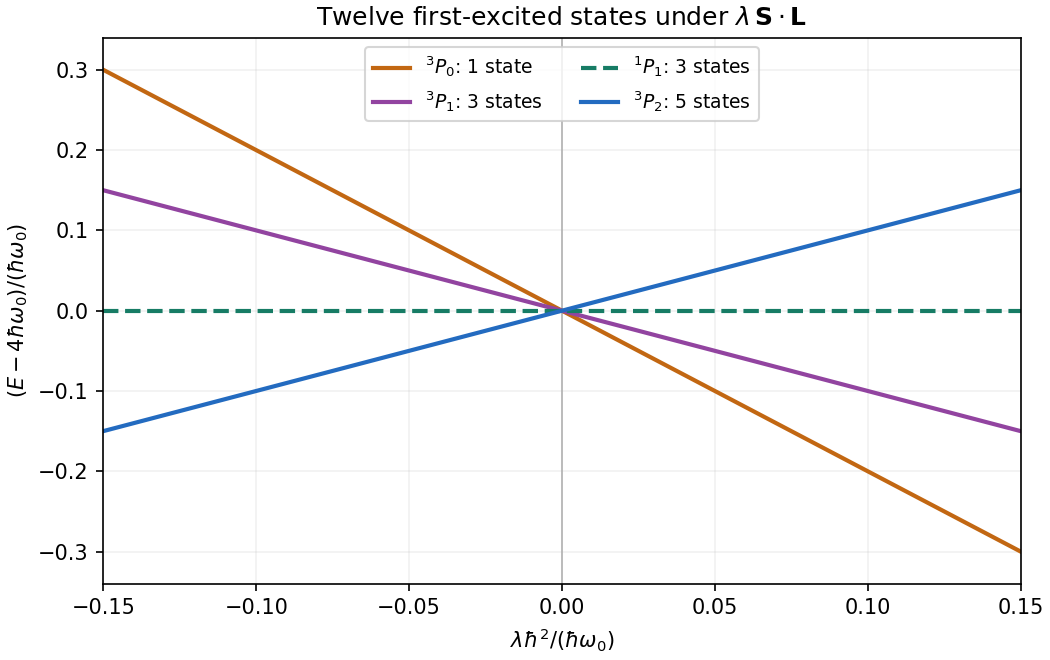
For the specified spin-orbit interaction, and are the total two-electron operators. Set . The spin-dot-product eigenvalue identity givesFor the singlet, and the shift is zero. For the triplet, . The spin-orbit splitting of the first excited two-electron oscillator level is consequentlyAdd each shift to . The multiplicities sum to twelve and their weighted shift sums to zero. For positive the table is ordered in energy; for negative the ordering reverses. Weak coupling means . Since this total-spin interaction commutes with , and , the shifts within this invariant manifold are in fact exact for the specified model, although only first order was requested.

New to topics? Read the docs here!