Conservation of angular momentum says that total angular momentum stays fixed when the net external torque about the chosen fixed inertial origin vanishes. Individual angular momenta and angular velocities can change. The radius change at constant angular momentum below makes this distinction visible: pulling two rotating point masses inward lowers the moment of inertia, raises the angular velocity, and supplies work that increases the kinetic energy.

Follow the same constant-mass point masses throughout, in an inertial frame, with all positions measured from a fixed origin . If the internal pair forces are opposite and central, meaning directed along each pair's separation, thenThus zero net external torque throughout an interval implies constant total angular momentum throughout that interval. A vanishing external torque component, such as , conserves the corresponding even when the other components change. This is the balance law for a fixed collection; angular-momentum flux must also be accounted for when matter crosses its boundary. [ref]
The central qualification is essential. Write for the internal force on member from member . Under Newton's third law, , but the sum of their torques isThis vanishes when is parallel to . Equal-and-opposite forces alone do not suffice: two opposite transverse forces with separated lines of action form a couple with nonzero torque. Cancellation of the internal pair torques, together with Newton's second law, proves the total balance above.
For one point mass under a central force about , gives . The force may still change the speed and kinetic energy; its zero torque preserves angular momentum. With nonzero , keeps the motion in a fixed plane. Choosing the axis perpendicular to that plane, governs its angular progress. This removes an unknown from the central-force radial turning point calculation and helps reduce the Kepler orbit to a radial problem.
There is a historical geometric version of this result. In Book I, Section II, Proposition I of the Principia, Newton proves that motion under a central force toward a fixed centre stays in a plane and sweeps equal areas in equal times, using successive central impulses and equal triangle areas. [ref]
https://en.wikisource.org/wiki/The_Mathematical_Principles_of_Natural_Philosophy_(1846)/BookI-II. Newton, Principia, Book I, Proposition I, Motte translation, 1846 edition
In the modern notation above, constant areal velocity is : the old geometric proof and the angular momentum calculation express the same invariant.For two equal point masses joined by a light tether of length , the central moment of inertia is . With conserved angular momentum , the rotational kinetic energy is . Slow, smooth contraction gives with the displayed leading tension. The exact radial correction is and , so the total work-energy theorem remains exact for non-quasi-static schedules too.
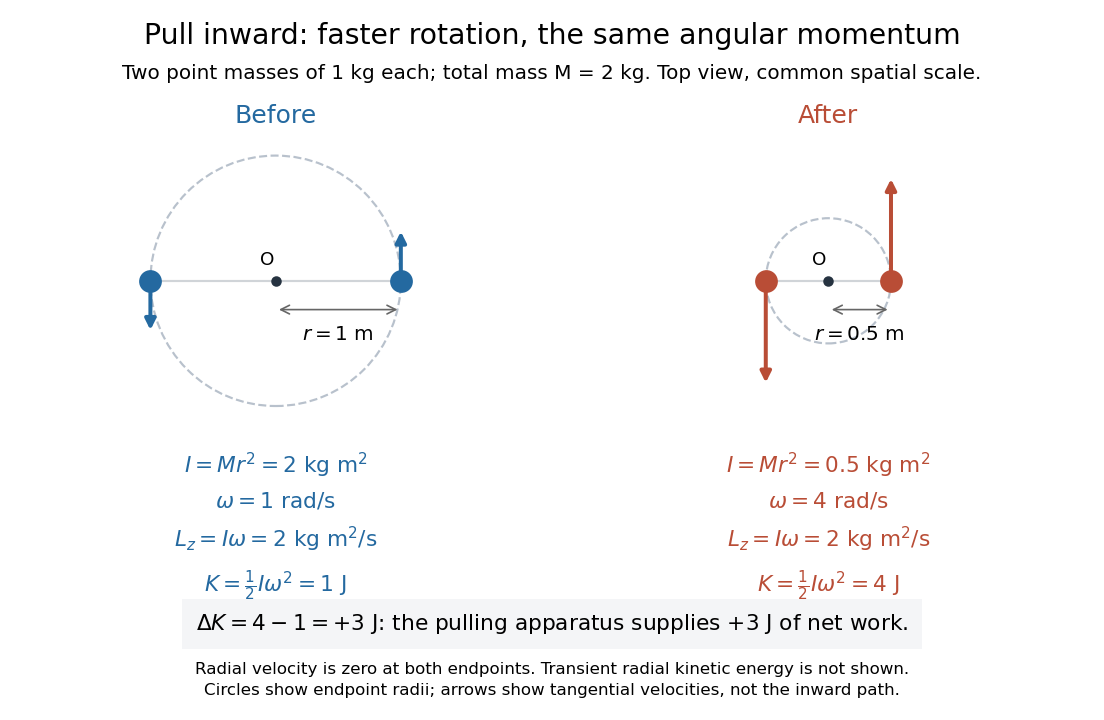
Place two equal point masses of each on opposite sides of a fixed origin, at equal radius , and let them share a signed angular velocity in a plane. Their total mass is and their moment of inertia about the perpendicular axis is . Radial pulling forces have zero torque about that origin, soTake an initial radius and angular velocity , and a final radius . ThenandThese are endpoint states with . During the pull, the full kinetic energy also contains radial motion: . Assume the pulling apparatus supplies all net work to the two point masses; the work-energy theorem then fixes its net work at , including any radial acceleration and braking. Each mass spirals inward during the pull, allowing its inward force to do positive work. Conservation of angular momentum therefore predicts the final angular velocity without requiring kinetic energy conservation. For an apparatus included in a larger system, its stored energy supplies the increase consistently with conservation of energy. OpenStax uses the same mechanism to explain a skater pulling her arms inward. [ref]
https://openstax.org/books/university-physics-volume-1/pages/11-3-conservation-of-angular-momentum. OpenStax, section 11.3: work during a change of moment of inertia
The rate at which angular momentum crosses a surface, including advection and stresses. With positive inward mass accretion rate, the net inward flux in a steady accretion disk is .
For unit mass in a central force with potential and conserved angular momentum , a radial turning point has zero radial speed and therefore satisfies
For unit mass, incoming speed , impact parameter , and potential energy , put . At closest approach, conservation of energy and conservation of angular momentum give the displayed radii and tangential speeds . Consequently and . These relations compare equal force magnitudes. The attractive radial case is a singular collision, so the speed-product statement does not extend to that endpoint.
Articles by others on the same topic
There are currently no matching articles.