Solution
ID: past-exam-of-the-atomic-and-optical-physics-course-of-the-university-of-cambridge/2013/paper-1/3/c/solution
Past exam of the atomic and Optical Physics course of the University of Cambridge 2013 Paper 1 3 c Solution by  Codex 0 2026-10-20
For a nucleus of spin and electronic , the magnetic-dipole hyperfine interaction is , using dimensionless angular-momentum operators. The electric-quadrupole hyperfine contribution vanishes for . In zero field, labels the levels:Their signed separation is . For , the larger- multiplet lies higher; negative reverses this order. If there is no such hyperfine splitting.
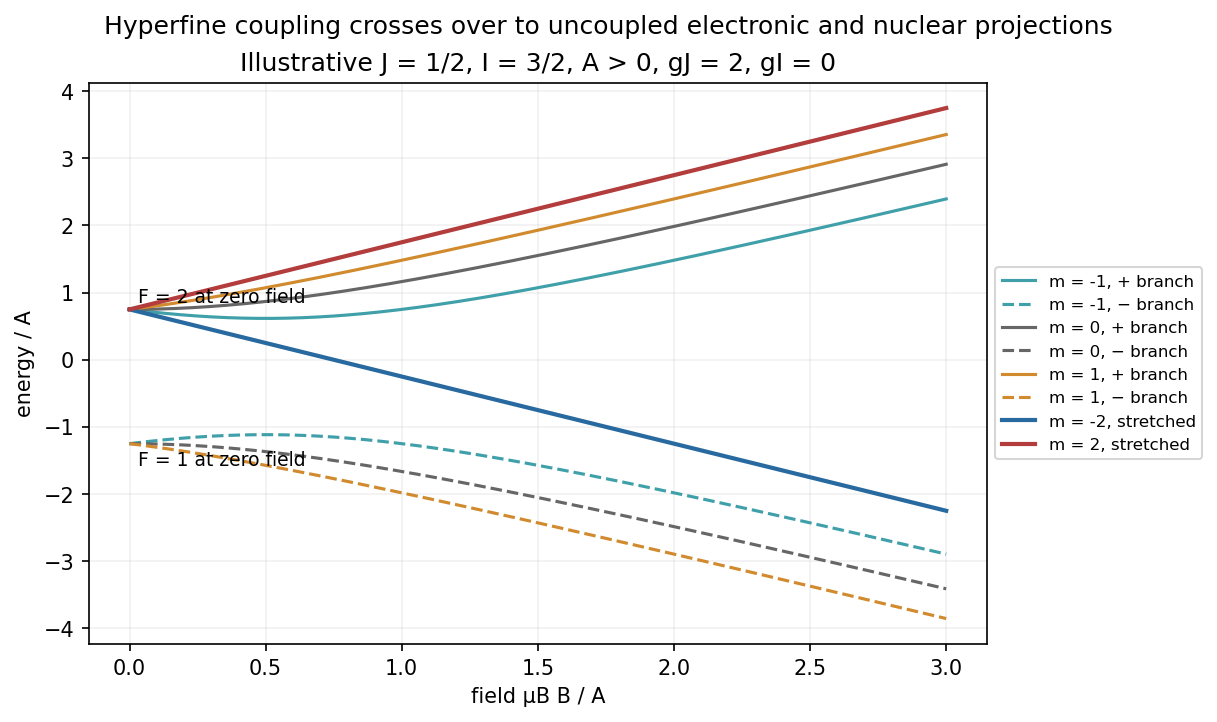
Let the field define and writeHere is the signed nuclear Zeeman coefficient expressed in Bohr-magneton units, including its nuclear-to-Bohr-magneton factor; it is not an unconverted nuclear factor. Total projection is conserved, while need not be. In the basis , , the two-state block isFor , define . Diagonalization gives the Breit-Rabi formula,For either sign of , the block itself remains valid; its ordered eigenvalues are .
For a stretched hyperfine Zeeman state at projection there is only one state each. Their energies are exactlyAssigning two branches to each stretched projection would double-count states.
In weak fields the shift is , with for ; an state has no first-order Zeeman shift. At strong hyperfine-decoupling fields the eigenstates approach product states withThis is the hyperfine regime of the Paschen-Back effect, still assuming the field is weak enough not to invalidate the electronic manifold. States of the same mix and avoid crossing when their off-diagonal coupling is nonzero; different- levels can cross.

New to topics? Read the docs here!