Solution
ID: past-exam-of-the-chemistry-b-course-of-the-university-of-cambridge/2022/paper-2/b6/c/solution
Past exam of the chemistry B course of the University of Cambridge 2022 Paper 2 B6 c Solution by  Codex 0 2026-10-20
Four equivalents of base remove the four carboxylic-acid protons from two ligand molecules, giving two dianionic pyridine-2,5-dicarboxylate linkers per Pt/Mn pair. The ring nitrogen and neighbouring 2-carboxylate supply a five-membered N,O chelate. A consistent chain has Pt(II), NO, with square planar molecular geometry, and Mn(II), O, with octahedral molecular geometry.
At each Pt, two ligands bind through their ring N and one O of the adjacent 2-carboxylate; their remote 5-carboxylates point toward successive Mn sites. At each Mn, a remote carboxylate from each of two neighbouring Pt-containing units binds through both O atoms. Two coordinated water molecules complete Mn's six-coordinate sphere. The repeating connectivity, with each bracket denoting a single organic linker, isEach Pt has a second N,O chelate extending in the opposite chain direction; each Mn similarly receives two carboxylate chelates. The original donor-connectivity diagram makes those counts explicit.
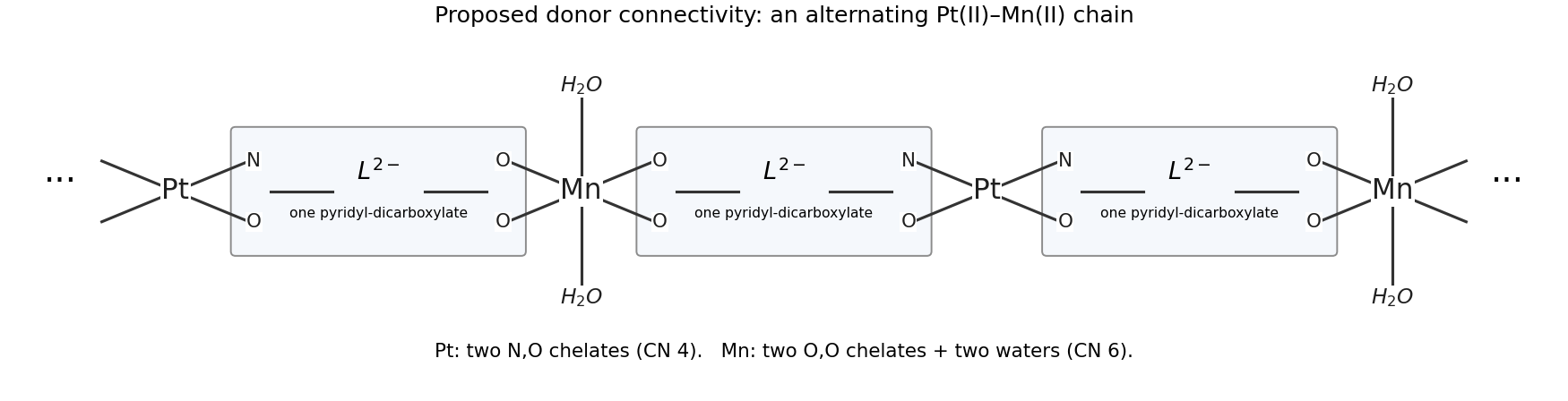

Pt(II) is and strongly favours square planar molecular geometry. Its affinity for the pyridyl N donor and the chelate effect select the mixed N,O pocket. Mn(II) is high-spin , is harder, and favours the carboxylate and water O donors; six-coordinate octahedral molecular geometry is natural in water. Charge balance per repeat is . A suitable repeat formulation is . This is a justified proposed coordination chain, not a unique crystal structure established from stoichiometry alone; water content, carboxylate bridging modes and actual porosity require structural characterization.
New to topics? Read the docs here!