Stoichiometry relates the quantities consumed and formed in a chemical reaction. Its coefficients are ratios of entity counts, or equivalently of amount of substance, rather than ratios of masses. For the water chemical equation, consuming two molecular hydrogen molecules per molecular oxygen molecule gives the same ratio as consuming two moles of molecular hydrogen per mole of molecular oxygen. Multiplying every entity count by the same factor preserves the ratio. See Flowers et al., Chemistry 2e, reaction stoichiometry.
Coefficients and subscripts do different jobs. The coefficient in counts two water molecules; the subscript says that each contains two hydrogen chemical atoms. Changing coefficients scales quantities. Changing a subscript changes the specified chemical substance.
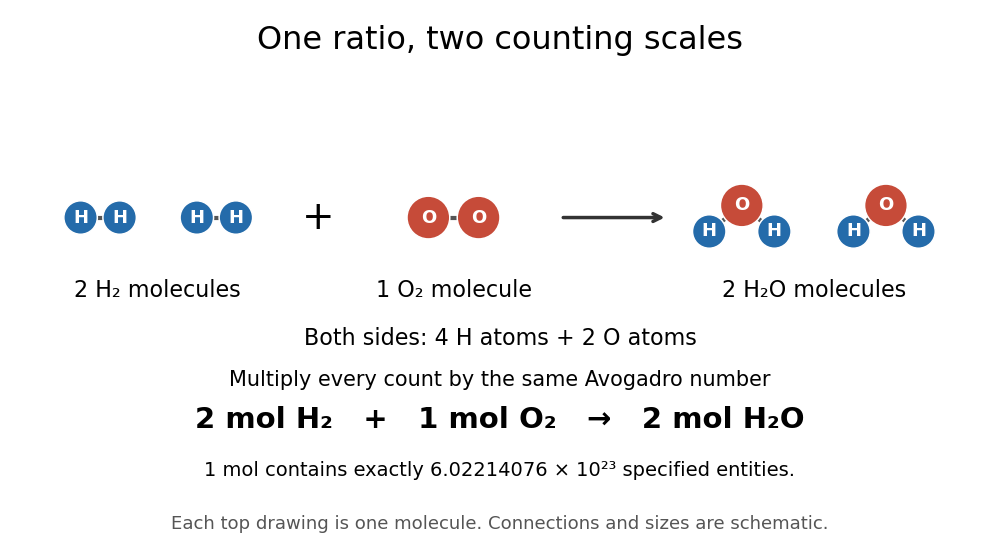
The same stoichiometric ratio at molecular and molar scales
. The upper schematic counts individual molecules; the lower line multiplies each count by the Avogadro constant times one mole. Circle sizes and positions are illustrative. Details.This distinction catches a common counting error: one mole of water molecules contains two moles of hydrogen chemical atoms and one mole of oxygen chemical atoms. Always specify what is counted.
Stoichiometry records reactant and product multiplicities in a chemical reaction or a chemical reaction network. The change caused by one reaction is its stoichiometric vector; multiplying by the reaction rate gives its contribution to the concentration equations. For two identical reactants the rate-constant convention absorbs any combinatorial factor.
The signed amount of species in a written chemical reaction, positive for products and negative for reactants. Multiplying all coefficients by a factor multiplies the standard Gibbs energy of reaction by that factor and raises the equilibrium constant to that power.
The molecular count is a dimensionless integer; the amount of substance has unit mole, symbol . They satisfyThe Avogadro constant is exact by the modern definition of the mole: see SI base unit: mole by Bureau International des Poids et Mesures. Thus two water molecules correspond to moles, whereas two moles of water contain molecules. A mole is a unit for counting specified entities, which may also be chemical atoms, ions or electrons.
For a closed system with one specified chemical reaction, the extent of reaction records progress from through . Here is the amount of substance of species , and the signed stoichiometric vector has negative entries for reactants and positive entries for reaction products. For the water chemical equation in the order , it is . The normalization of depends on the chosen coefficients. See IUPAC Gold Book, extent of reaction.
With particle numbers instead of molar amounts, a molecular extent obeys , and the chemical potentials are measured per particle. At fixed temperature and volume, the Helmholtz free energy then satisfies . An interior chemical equilibrium requires ; the molar convention gives the same relation with chemical potentials per mole.
The limiting reagent is the reactant exhausted first if the specified chemical reaction proceeds to the maximum conversion permitted by stoichiometry. With initial values of amount of substance for the reactants and positive consumption coefficients , the largest forward extent of reaction is . Compare these quotients, rather than simply choosing the smallest initial quantity. This calculation predicts the maximum reaction product quantity and identifies which reactant supply must increase to raise it. See Flowers et al., Chemistry 2e, limiting reactants.
Start with of molecular hydrogen, of molecular oxygen and no water. Assume complete conversion by the displayed chemical reaction, without competing reactions. ThenThe molecular oxygen is the limiting reagent. Consumption of of molecular hydrogen and of molecular oxygen forms of water, leaving of molecular hydrogen. Initially there are molecular hydrogen molecules and molecular oxygen molecules; after conversion there are water molecules and leftover molecular hydrogen molecules.
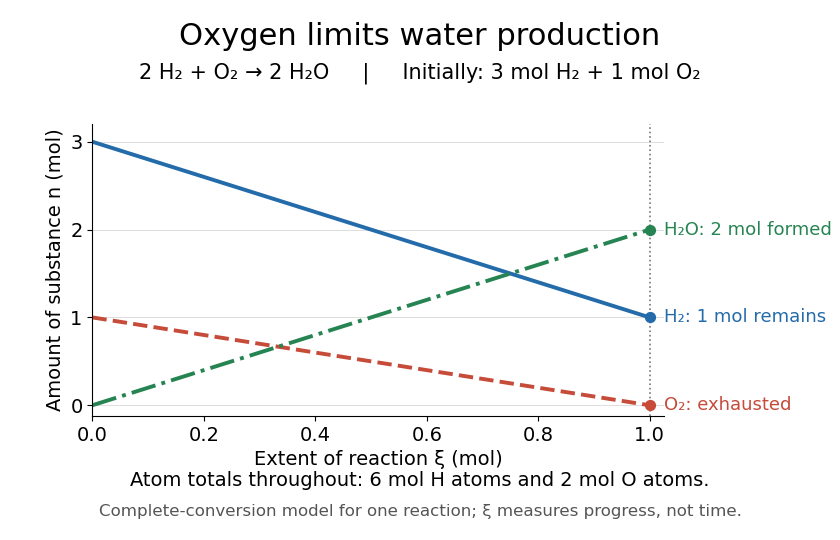
Oxygen runs out while one mole of molecular hydrogen remains
. The horizontal axis is extent of reaction, rather than time. The endpoint assumes complete conversion by one chemical reaction; the curves express stoichiometry. Details.As a check, the initial inventory has of hydrogen chemical atoms and of oxygen chemical atoms. The final water contains of hydrogen chemical atoms, and leftover molecular hydrogen supplies the remaining . The atom totals balance even though the total amount of substance of molecules falls from four to three moles.
Articles by others on the same topic



Stoichiometry is a branch of chemistry that involves the calculation of reactants and products in chemical reactions. It is based on the conservation of mass, meaning that the total mass of the reactants must equal the total mass of the products in a chemical reaction. Stoichiometry allows chemists to predict the quantities of substances consumed and produced in a given reaction, based on balanced chemical equations.