Solution
ID: past-exam-of-the-chemistry-b-course-of-the-university-of-cambridge/2023/paper-2/b10/a/solution
Past exam of the chemistry B course of the University of Cambridge 2023 Paper 2 B10 a Solution by  Codex 0 2026-10-20
water stabilizes the planar amide more strongly relative to the twisted rotational transition region, increasing the free-energy barrier. nitrogen lone-pair donation into the carbonyl gives the C–N bond partial double-bond character through amide resonance, represented byamide bond rotation between the two amide conformations requires loss of favourable overlap. Near a strongly twisted geometry the nitrogen lone pair is less conjugated with C=O, and the charge-separated resonance in chemistry contribution is reduced. Polar water, a hydrogen bond donor, preferentially stabilizes the planar starting structures, including their polar carbonyl/resonance distribution, compared with this less conjugated rotational region. chloroform provides less of that differential stabilization. What controls the rate is the difference between the starting minimum and the transition state, not the absolute stabilization of either one in isolation.
For a first-order interpretation of the half-lives, the characteristic rate constants areThus the interconversion is 25 times slower in water. With comparable Eyring equation prefactors at the same temperature,which is about at . This temperature is illustrative because none is specified for the measurements.
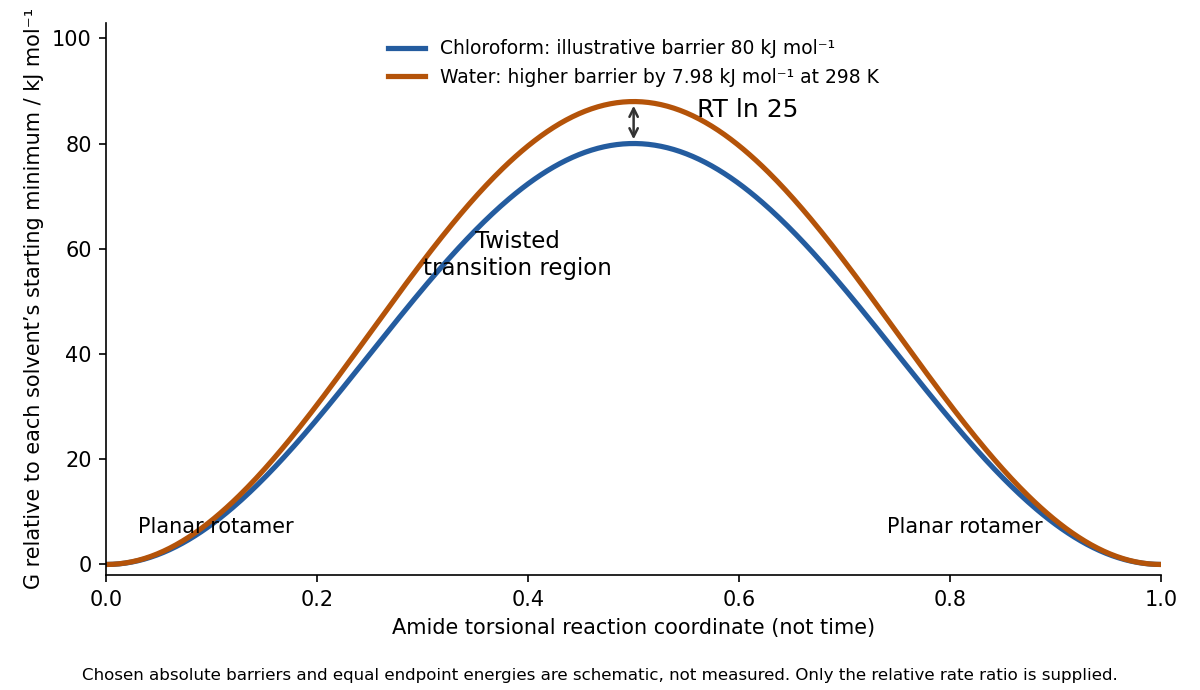

The two endpoint conformations remain minima separated by a twisted barrier in each solvent. The profiles are schematic, with arbitrary absolute barriers; the half-life ratio supports the relative kinetic comparison. If the quoted half-lives describe relaxation of a reversible cis/trans mixture, , so the ratio directly concerns relaxation rates. Assigning the full difference to one microscopic forward barrier additionally requires comparable equilibrium populations or directional-rate information.
New to topics? Read the docs here!