Solution
ID: past-exam-of-the-chemistry-b-course-of-the-university-of-cambridge/2025/paper-2/b10/a/i/solution
Past exam of the chemistry B course of the University of Cambridge 2025 Paper 2 B10 a i Solution by  Codex 0 2026-10-20
Use C1 for the carbonyl carbon, C2 for the adjacent carbon, and C3 for the beta carbon of the reactive enone fragment . water adds conjugately at C3, giving a beta-hydroxy ketone. The oxygen lone pair of neutral water attacks C3; move the C2=C3 pi pair toward C1–C2 and the carbonyl pi pair onto oxygen. This produces the charge-separated enolate–oxonium intermediateA second water molecule can relay a proton from the newly attached oxonium oxygen to the enolate system. Using the carbon-centered resonance structure, reform C1=O and protonate C2 while the donating O–H bond returns its pair to the added oxygen. Equivalently, oxygen protonation first gives an enol, followed by water-mediated keto-enol tautomerism. Either path yields a neutral beta-hydroxy ketone and regenerates the relay water. There is no need to introduce externally supplied H or OH; solvent molecules perform the proton transfers. The uncatalyzed charge separation has a large barrier, so this mechanism describes a slow formal pathway, not a claim of rapid hydration in pure water.
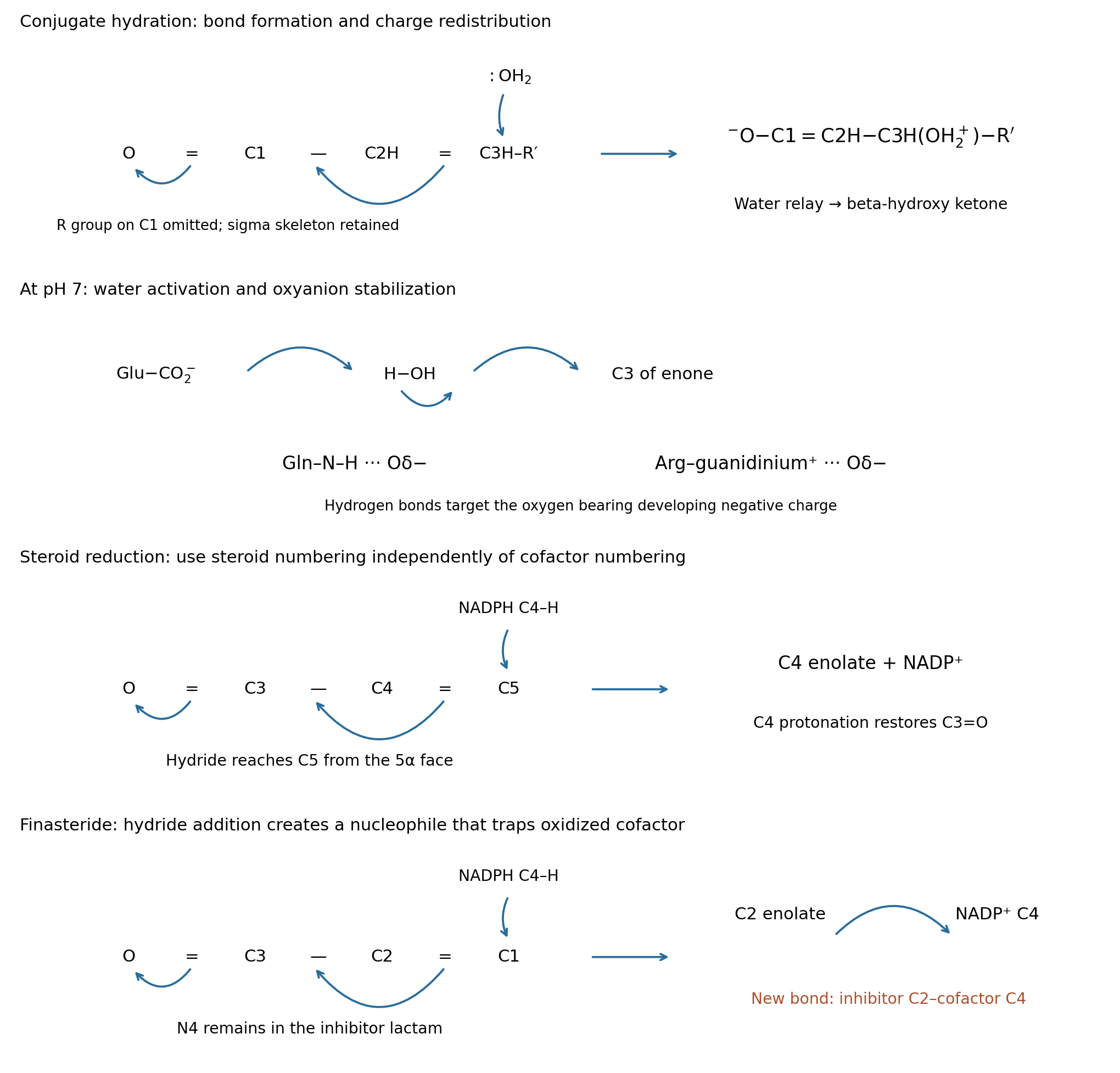
Reactive-fragment mechanisms for conjugate hydration, steroid reduction and finasteride trapping
. Details. 
New to topics? Read the docs here!