Solution
ID: past-exam-of-the-chemistry-course-of-the-year-1-of-the-natural-sciences-course-of-the-university-of-cambridge/2021/paper-1/3/b/i/solution
Past exam of the chemistry course of the year 1 of the natural sciences course of the University of Cambridge 2021 Paper 1 3 b i Solution by  Codex 0 2026-10-20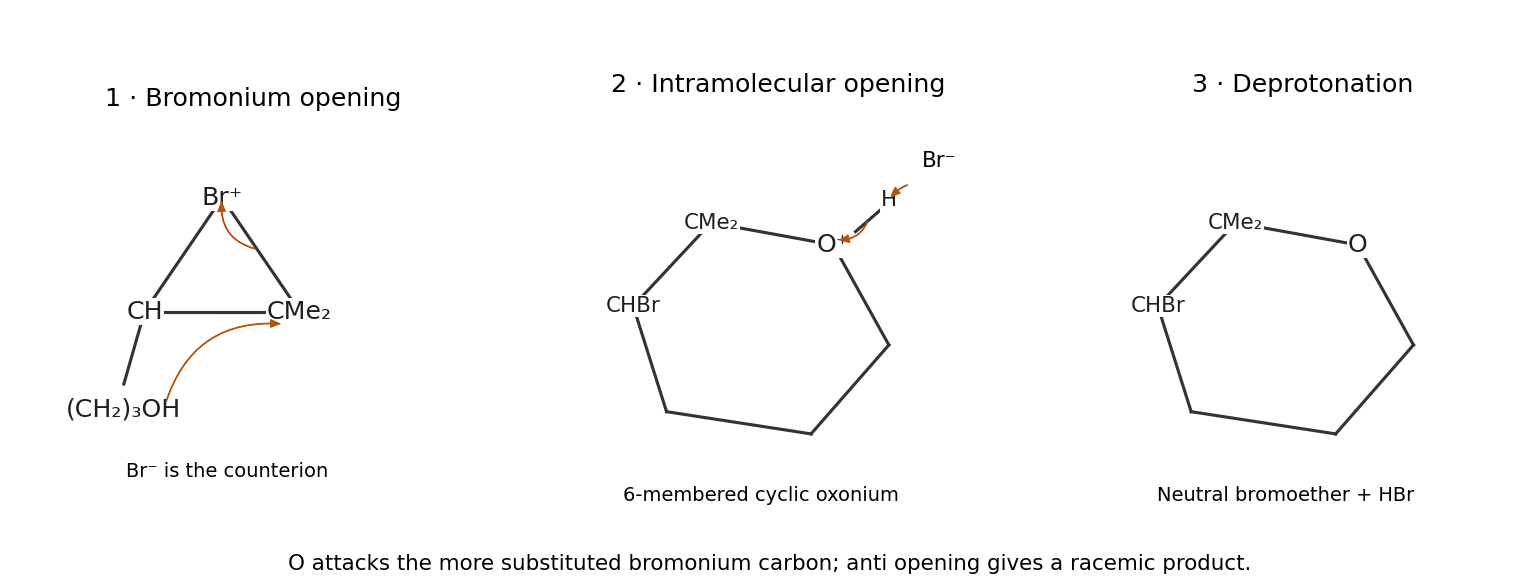
Bromonium formation and intramolecular opening give the six-membered cyclic bromoether
. Details. 
The alkene pi bond attacks Br as the Br-Br bond breaks to bromide, forming a bridged, unsymmetrical bromonium ion. The carbon bearing the two methyl groups has greater carbocation-like character.
The tethered alcohol oxygen attacks that carbon from the side opposite the bromine bridge. Its lone pair forms the new O-C bond while the attacked C-Br bridge bond opens, giving a six-membered cyclic oxonium ion. Bromide or solvent removes the O-H proton to give the neutral bromoether.
This explains why O becomes attached at the more substituted alkene carbon while Br remains at the other carbon. Polar solvent assists charge separation, and intramolecular capture competes effectively with external bromide attack. Opening is anti; attack on the two faces of the achiral starting material gives a racemic product at the newly formed CHBr stereocentre.
The ring-forming step is bromoetherification.
New to topics? Read the docs here!