Solution
ID: past-exam-of-the-chemistry-course-of-the-year-1-of-the-natural-sciences-course-of-the-university-of-cambridge/2022/paper-1/3/c/solution
Past exam of the chemistry course of the year 1 of the natural sciences course of the University of Cambridge 2022 Paper 1 3 c Solution by  Codex 0 2026-10-20
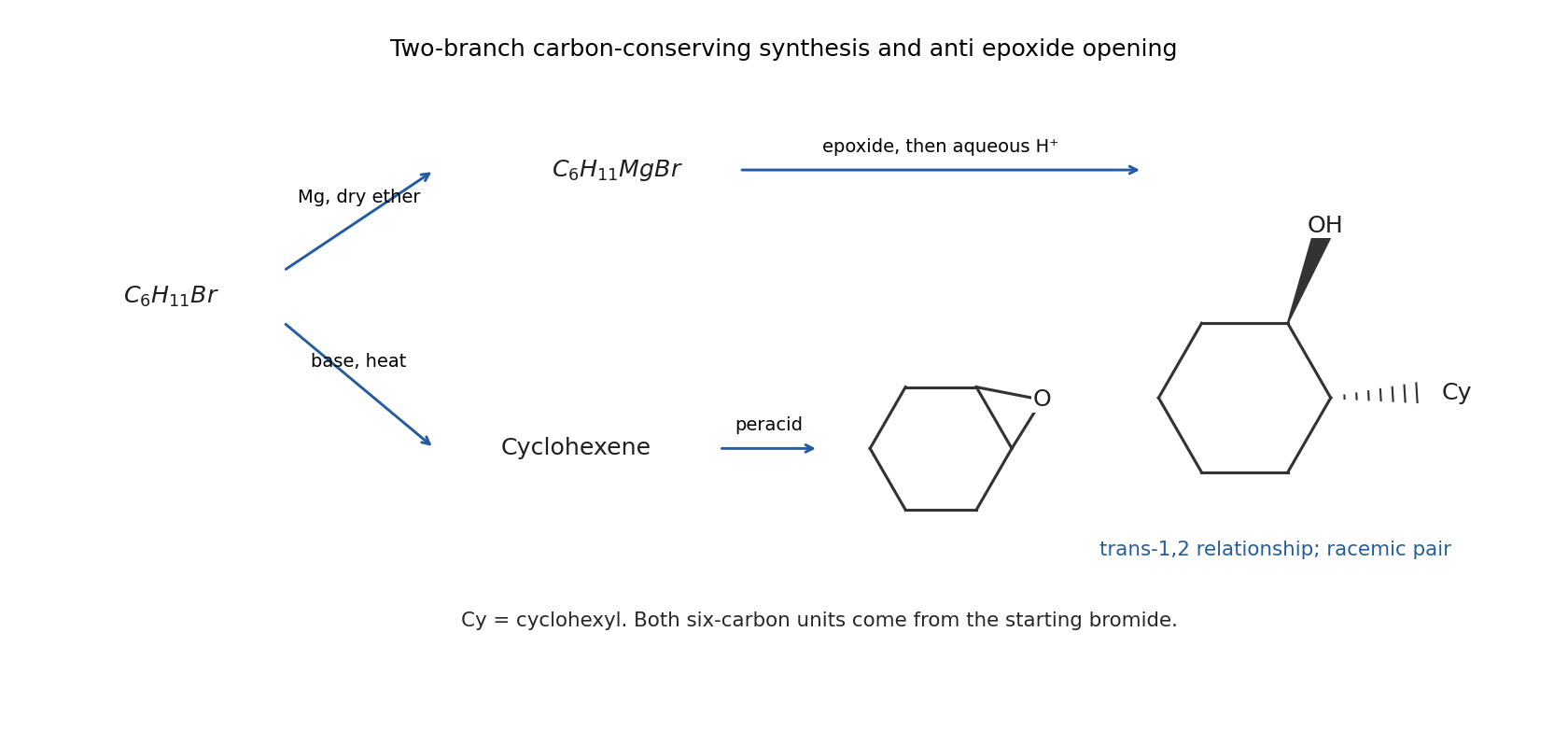
Disconnect the new bond between the two six-carbon units. One portion of bromocyclohexane supplies a grignard reagent; another supplies cyclohexene oxide:A bulky strong base can favour E2 elimination in the alkene-forming step; a peracid such as meta-chloroperoxybenzoic acid provides epoxidation. None of its carbons enters the target.
Treat cyclohexene oxide with cyclohexylmagnesium bromide, then perform acidic aqueous work-up. Backside attack on one epoxide carbon breaks its C–O bond and installs cyclohexyl opposite the retained oxygen. Protonation of the oxygen gives trans-2-cyclohexylcyclohexan-1-ol, the required relative configuration. The two six-carbon reactant portions supply all 12 target carbons. An achiral synthesis produces a racemic mixture trans pair; obtaining only the particular enantiomer represented by the drawing would require resolution or an enantioselective step. The useful stable chair can place the two large trans-1,2 substituents approximately diequatorial.

New to topics? Read the docs here!