Solution
ID: past-exam-of-the-chemistry-course-of-the-year-1-of-the-natural-sciences-course-of-the-university-of-cambridge/2022/paper-1/6/b/i/solution
Past exam of the chemistry course of the year 1 of the natural sciences course of the University of Cambridge 2022 Paper 1 6 b i Solution by  Codex 0 2026-10-20
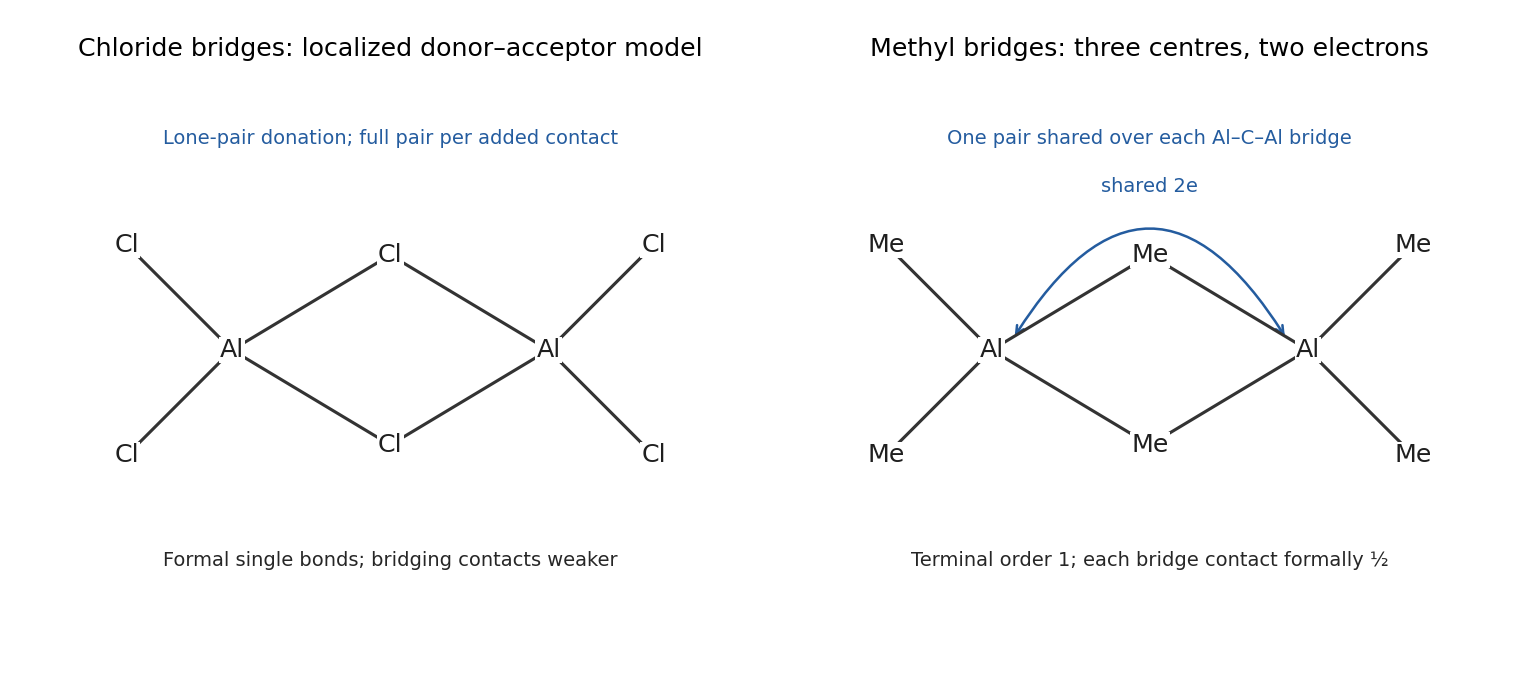
The four terminal methyl groups form ordinary Al–C sigma bonds, with formal bond order one. Each of the two bridging methyl carbons connects the two aluminium centres through a three-centre two-electron bond. One occupied bonding combination extends over Al–C–Al; the other combinations are unoccupied in the simple electron-deficient bridge model. A single shared pair therefore supplies one bond in total across the two contacts, giving formal Al–C bridge bond order per contact, compared with one for terminal Al–C.
Each aluminium has approximately tetrahedral, -like orbital directions. A terminal methyl carbon uses -like orbitals for its three C–H bonds and its Al–C bond. A bridging methyl carbon still uses three directed orbitals for C–H bonding, while its remaining approximately hybrid overlaps with orbitals on both aluminium atoms. This shared bridge avoids placing five independent ordinary two-electron bonds around carbon. The hybrid labels are idealized and the bridge geometry is distorted; the four occupied C–H/bridge orbital directions are not equivalent to five localized carbon bonds.

New to topics? Read the docs here!