Solution
ID: past-exam-of-the-chemistry-course-of-the-year-3-of-the-natural-sciences-course-of-the-university-of-cambridge/2022/paper-1/9/d/solution
Past exam of the chemistry course of the year 3 of the natural sciences course of the University of Cambridge 2022 Paper 1 9 d Solution by  Codex 0 2026-10-20
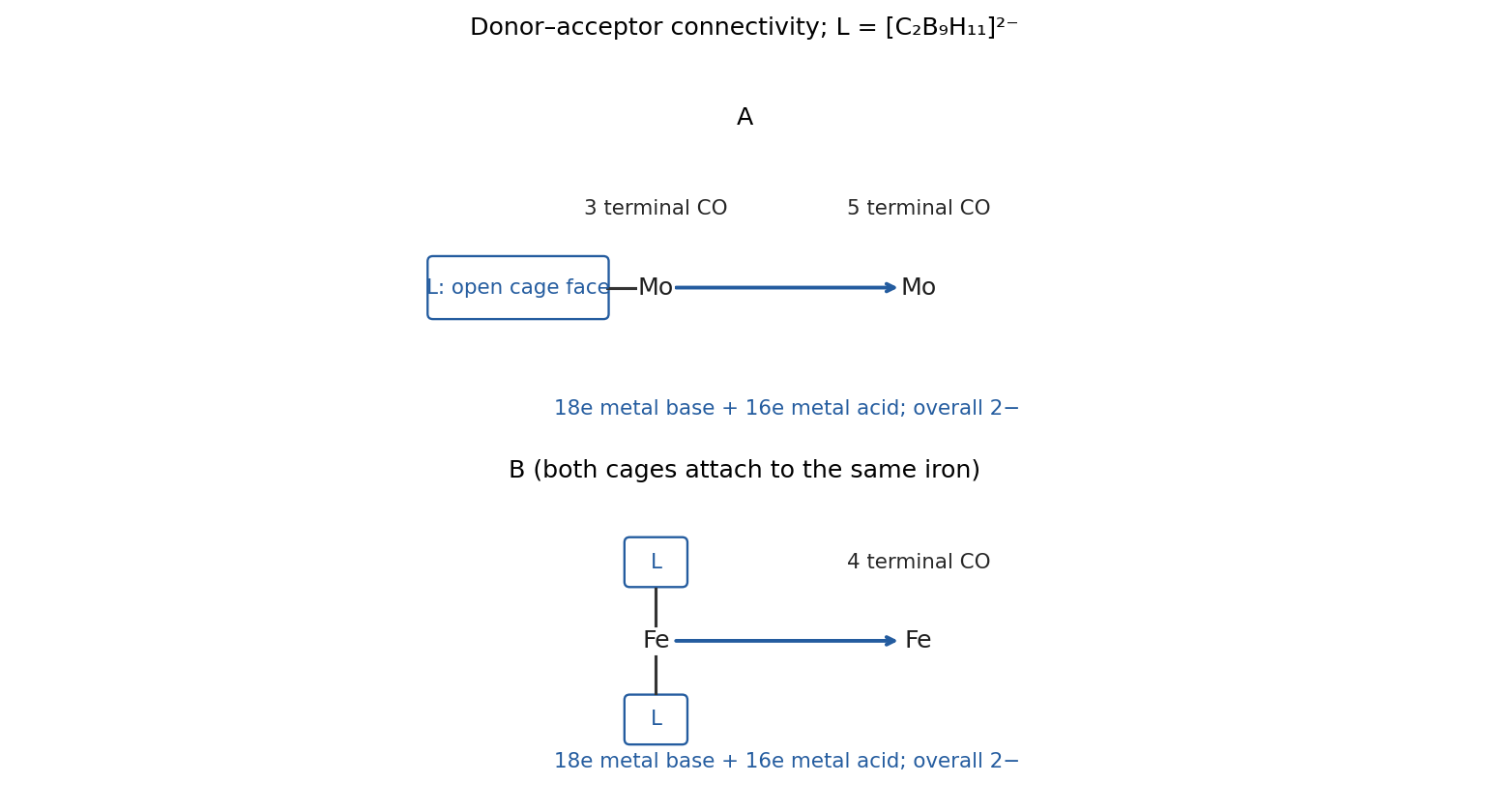
Write for the open-face dicarbollide ligand. The structure consistent with the stated attachment is , with a direct Mo–Mo connection, three carbonyls on the cage-capping Mo and five on the outside Mo. The first Mo has an interaction with the five-vertex face and completes a 12-vertex metallacarborane cage; the second is exo to that cage. The two tetramethylammonium ions are counterions.
The unsaturated fragment is a 16-electron Lewis acceptor; is an 18-electron metal-base fragment in ionic counting, . Donation from a filled Mo-based orbital supplies the external fragment with a pair. This donor–acceptor representation avoids the mistaken claim that both initially saturated 18-electron fragments simply add a new conventional bond without changing anything.
An alternative formal oxidation-state allocation for a single covalent Mo–Mo bond is cage Mo(I) and external Mo(−I): the local counts are and . These are electron-bookkeeping alternatives to the metal-base/metal-acid picture, not a measurement of integral site charges. With terminal carbonyls, the external group can be approximately octahedral when the Mo–Mo direction occupies its sixth coordination direction. The cage-containing unit must accommodate an exo metal interaction in addition to its facial cage/CO environment; its geometry need not be a perfectly undistorted isolated half-sandwich.

New to topics? Read the docs here!