Solution
ID: past-exam-of-the-chemistry-course-of-the-year-3-of-the-natural-sciences-course-of-the-university-of-cambridge/2022/paper-3/44/a/ii/solution
Past exam of the chemistry course of the year 3 of the natural sciences course of the University of Cambridge 2022 Paper 3 44 a ii Solution by  Codex 0 2026-10-20
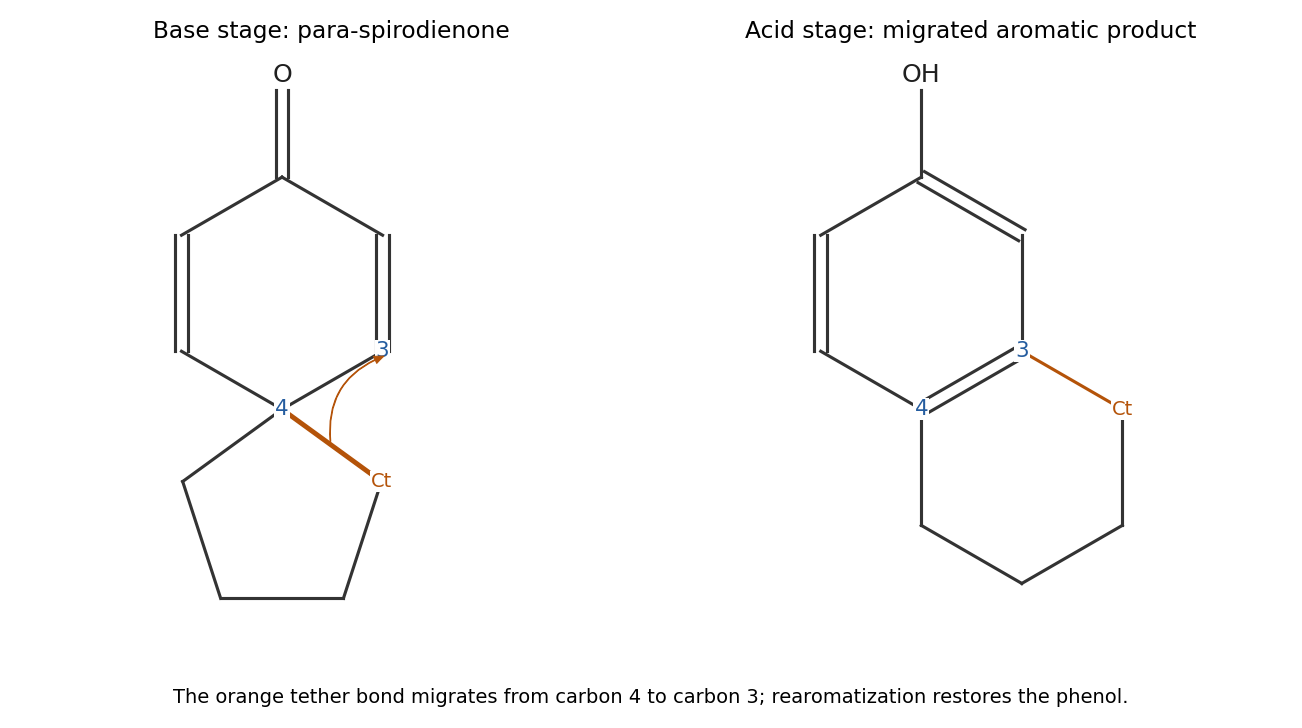
Base first gives phenoxide. Use its para-carbanion/quinoid resonance contributor: the para carbon bearing the tether attacks the terminal chloromethylene carbon in an intramolecular substitution, ejecting chloride. This forms a five-membered ring at that carbon and produces a para-spirocyclohexadienone, with the phenoxide oxygen becoming a carbonyl oxygen. The first stage is a dearomatizing spirocyclization of a phenoxide.
On acidification, carbonyl protonation makes the dienone electrophilic. A tether C–C bond attached to the spiro centre migrates to the adjacent dienone carbon, with the accompanying pi-bond shifts; loss of a proton restores aromaticity. This dienone-phenol rearrangement converts the spiro five-membered ring into the fused six-membered ring while regenerating the phenolic OH. The apparent bond formation meta to OH is thus explained by para spirocyclization followed by skeletal migration, rather than requiring the final fused connectivity to form directly in the base step.

New to topics? Read the docs here!