Solution
ID: past-exam-of-the-chemistry-course-of-the-year-3-of-the-natural-sciences-course-of-the-university-of-cambridge/2022/paper-4/51/c/v/solution
Past exam of the chemistry course of the year 3 of the natural sciences course of the University of Cambridge 2022 Paper 4 51 c v Solution by  Codex 0 2026-10-20
Within the stated ECEC model and with CO genuinely in large excess, its concentration is effectively constant. Both capture steps are then pseudo-first-order in the quinone species, and at the same scan rate the faradaic current is linear in bulk AQ concentration.
The sketch therefore retains the peak potentials, sweep directions and relative features of the trace, including the positive-potential return feature III, but reduces the faradaic current scale by a factor of ten. Charging/background current need not scale with AQ concentration and should be shown separately. A changed normalized shape would indicate effects outside this simple scaling limit, such as CO depletion, adsorption or reactions between quinone species.
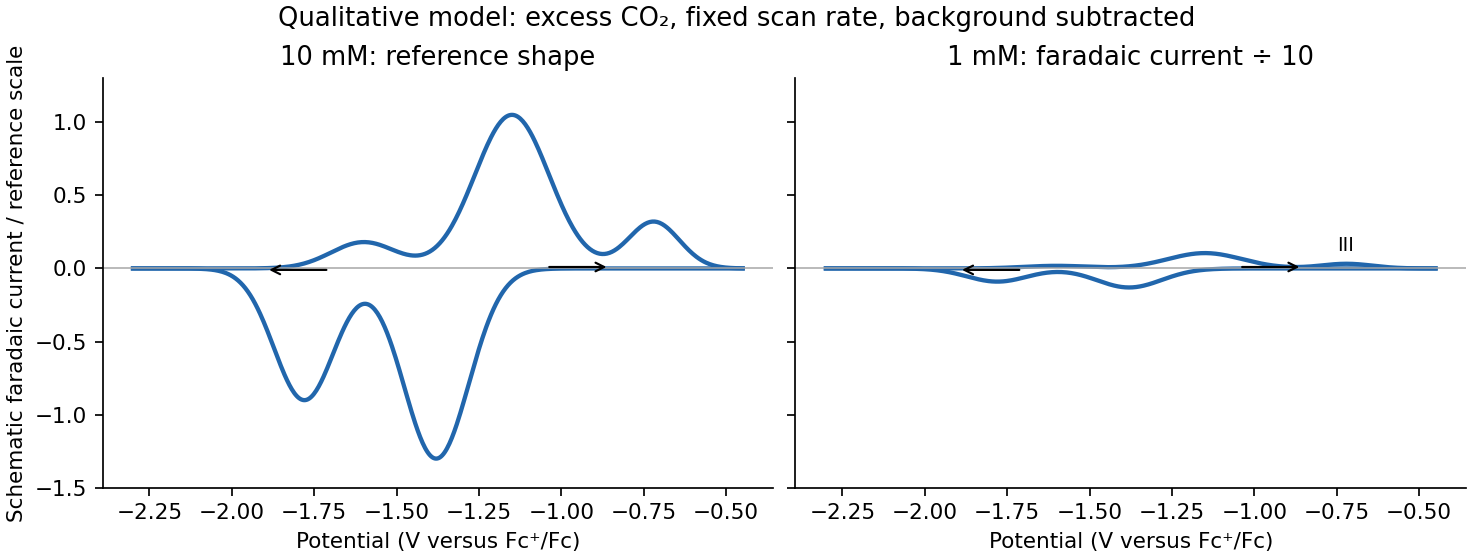
Qualitative tenfold faradaic-current scaling at fixed scan rate and excess carbon dioxide
. Details. 
New to topics? Read the docs here!