Adsorption is accumulation of a substance at an interface. Binding a solute to a packing surface can delay its passage through a chromatography column. Ideal size-exclusion chromatography separates through SEC pore access without such binding; extra retention from adsorption requires a different interpretation.
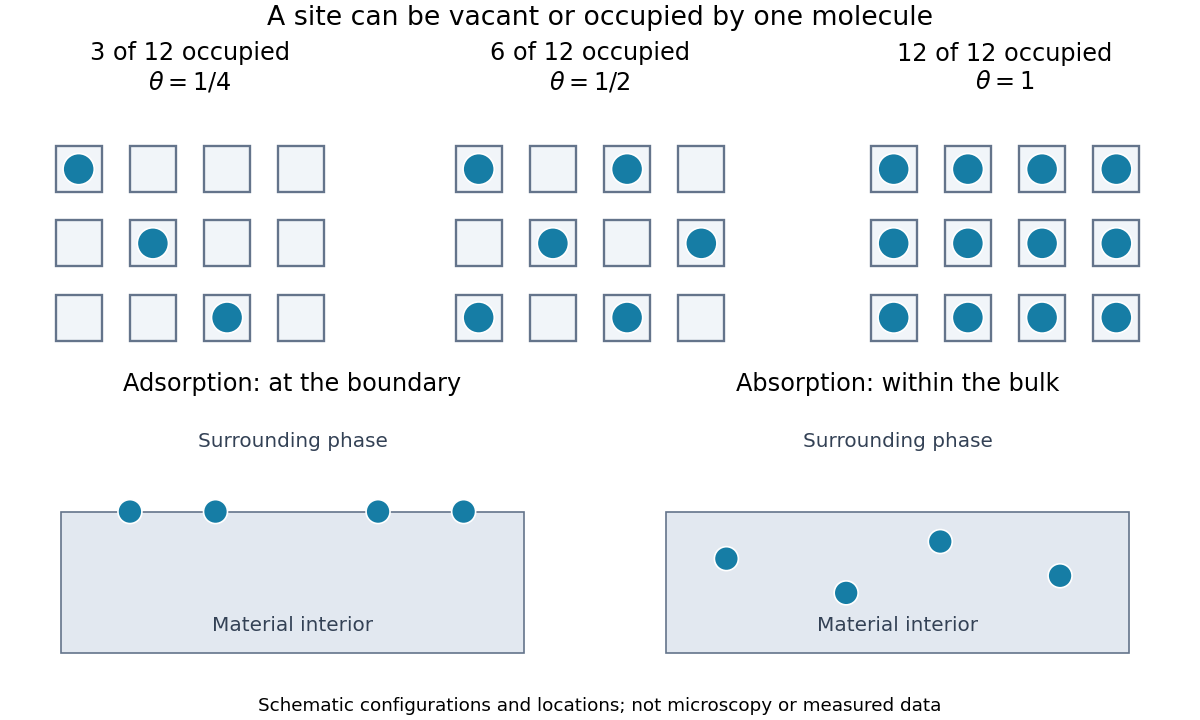
For a gas contacting a solid, adsorption concentrates molecules at the boundary; absorption takes material into the bulk. A porous solid can have a large internal surface area: binding on pore walls is still adsorption, even though those walls lie inside the particle. Both processes can occur together. Desorption returns adsorbed material to the surrounding phase. The useful question is therefore not just how much material disappeared from the gas, but where it went and whether it returns when the pressure falls.
An adsorption site model turns this spatial distinction into counting. With twelve identical adsorption sites and three bound molecules, the surface coverage is . Filling six gives ; filling twelve gives a complete monolayer. These are configurations illustrating the count, rather than measured arrangements or claims that all real surfaces have twelve sites.
The time dependence of an effluent concentration as retention capacity is approached or exhausted. Its early tail matters when a minimum retention time is required.
The translational Helmholtz free energy cost of restricting a dilute ideal gas from a volume to an area at the same temperature. For identical particle number and mass,Here is the thermal de Broglie wavelength. This contribution is positive for ; a favourable binding energy must be added separately to predict net adsorption.
A species bound at a surface. A measured orientational distribution need not imply one unique adsorption site or bonding geometry.
The Brunauer-Emmett-Teller multilayer adsorption model, distinguishing first-layer binding from higher layers. Suitable portions of an adsorption isotherm can estimate accessible surface area.
The probability that an impinging species is retained at a surface under specified conditions. Incident flux alone does not fix net surface accumulation when sticking is incomplete or desorption occurs.
Carbon-end bonding of CO to Pt can combine donation from a molecular sigma orbital with metal-to-CO pi back-donation. The resulting hybridization and local-potential changes can shift the Pt core binding energy and modify the molecule's vibrational spectrum. A measured core-level shift includes core-hole screening and does not uniquely specify a net transferred charge.
Adsorption in which material can form more than one layer above a surface. The number of adsorbed particles per underlying site can exceed one and differs from the fraction of sites having any adsorbate.
An ideal column model with the same adsorption-to-desorption ratio at every height. With , the stationary height distribution is for , and its mean is . Unlimited height makes the mean diverge as ; at no normalized equilibrium height distribution exists.
The interfacial excess of a species relative to bulk reference phases extrapolated up to a chosen reference surface. An excess number density per area is denoted ; its molar counterpart is . When an interface is dominated by a molecular layer, an effective area per adsorbed molecule is . The reference-surface convention matters in multicomponent systems.
An adsorption site is a position or local environment at which a chemical species can be retained at a boundary. Treating all adsorption sites as identical is an assumption about their binding properties, not a definition of adsorption.
In a one-molecule-per-adsorption site description, surface coverage is , with . For a macroscopic sample at chemical equilibrium, usually denotes the mean occupied fraction. Inferring it from total uptake also requires the capacity of a complete monolayer.
A monolayer is a single layer of chemical atoms or molecules. In the Langmuir adsorption model, a complete monolayer occupies every adsorption site; partial surface coverage leaves vacancies within that first layer. One layer need not mean one molecule per surface chemical atom.
Desorption releases material previously retained at a boundary. At chemical equilibrium, adsorption and desorption can both continue while their mean rates balance.
An adsorption isotherm relates equilibrium uptake to surrounding pressure or concentration at fixed temperature. For a gas, specify the partial pressure of the adsorbing chemical species. An uptake trace during incomplete equilibration need not be an adsorption isotherm.
For the simple one-solute interface convention, surface excess per molecule is related to the derivative of surface tension with respect to the logarithm of solute activity by the displayed equation. For ideal dilute behavior one may use concentration ratios in place of activity ratios. In molar units, . A local molecular area estimate is . Ionic surfactants can require counterion and activity factors; the simple single-component expression must not be transferred to them without specifying those constraints.
Consider an ideal gas in chemical equilibrium with homogeneous, identical adsorption sites at fixed temperature. Each intact molecule occupies one site; only one monolayer is allowed. Occupation of distinct sites is independent: neighboring bound molecules do not change binding or release rates. The simplest Langmuir adsorption model has one adsorbing chemical species, no splitting of molecules, and no competitors. Irving Langmuir's 1918 paper treats simple adsorption alongside more complicated cases; its scope exceeds this particular model.[ref]
The Adsorption of Gases on Plane Surfaces of Glass, Mica and Platinum by Irving Langmuir. Langmuir, The Adsorption of Gases on Plane Surfaces of Glass, Mica and Platinum, 1918, theoretical part: Case I and subsequent cases
The derivation is a balance between arrivals finding vacancies and departures from occupied adsorption sites. Let be the arrival-and-binding rate per vacant site and the departure rate per occupied site. Thus has units of inverse pressure per unit time, whereas has units of inverse time. The mean surface coverage obeysAt chemical equilibrium, setting the two terms equal givesThe product is dimensionless. Here is the adsorbing gas's partial pressure, expressed in modern bar, with , and is expressed in . The pascal is the SI unit of pressure. This dimensional is not itself a dimensionless thermodynamic equilibrium constant. A larger gives greater surface coverage at the same and temperature, but does not specify how quickly chemical equilibrium is reached: multiplying both rate coefficients by the same factor leaves unchanged.
Choose , , and as illustrative parameters at one fixed temperature, without assigning a particular material. At , substitution gives, respectively,Solving gives : the three half-occupation pressures are , , and . For , reaching instead requires , or . If the complete-monolayer capacity is stipulated to be , then predicts at . This last number is an original hypothetical example, not a measured uptake.
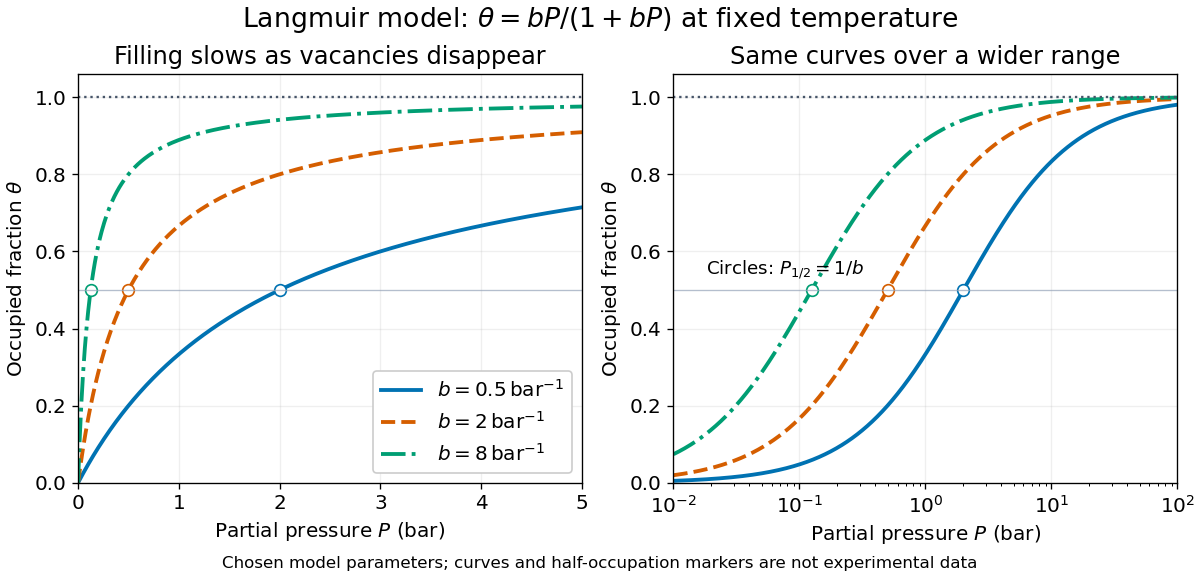
Langmuir isotherms for three chosen values of
. Original model curves at fixed temperature, with in modern bar and , , and . Open circles mark the calculated half-occupation points, not experimental observations. The panels show the same curves on linear and logarithmic pressure axes; the horizontal dashed line marks complete-monolayer capacity. No curve is historical data or a fit to a particular material. Details.The shape follows directly from the finite number of adsorption sites. For , : nearly every arriving molecule finds a vacancy. For , : vacancies become scarce. More formally,Thus surface coverage rises with diminishing slope and approaches one only as . This saturation is a site-capacity limit, not a claim that the gas has reached its condensation pressure. A second layer, different site binding strengths, interactions between bound molecules, or a changing surface invalidate parts of the setup. A good fit alone does not establish identical adsorption sites: a restricted pressure range can hide such differences. The Langmuir adsorption model is useful because it makes the capacity and the pressure scale of filling separate, testable quantities.
Equating the site chemical potential with that of an internally structureless classical vapour gives . The coefficient includes the bound vibrational partition factor, the translational thermal de Broglie wavelength, and the positive binding Boltzmann factor. It has inverse-pressure units. Half coverage occurs at ; an unspecified prevents a numerical pressure scale, but not the functional isotherm.
An independent site has one empty state and an occupied set with binding energy and vibrational partition function . Its occupied probability is . The denominator enforces the one-molecule-per-site constraint even though the vapour may obey classical statistics. Multiple occupancy or lateral interactions require a different model.
The occupied-to-vacant probability ratio of the adsorption-site grand partition function is . Taking its logarithm yields the displayed chemical potential. binding energy and vibrational energies must share a consistent reference so that zero-point energy is not counted twice.
The chemical potential of an ideal single-occupancy lattice gas with occupied-site internal partition function and surface coverage . The ratio accounts for the entropy of distributing particles among occupied and vacant adsorption sites.
For independent spin-one-half adsorbates whose two spin states are split only at the surface, the one-site partition function contains . Relative to the unsplit bulk spin degeneracy, this increases the Langmuir adsorption model affinity by a hyperbolic-cosine factor. At fixed temperature and gas pressure, increasing the magnitude of the magnetic field increases surface coverage in this model.
Competitive adsorption occurs when different chemical species seek the same adsorption sites. For intact molecules and , retain identical adsorption sites and no interactions, but replace the vacant fraction by . The same equilibrium balance givesHere and are partial pressures, not total pressure. Increasing can reduce at unchanged : replacing by total pressure in a single-species Langmuir isotherm loses this competition.
In dissociative adsorption, an arriving molecule splits into bound fragments. For the idealized process , let denote a vacant adsorption site and let count sites occupied by . A mean-field approximation with independent vacancies takes the forward rate proportional to and the reverse rate proportional to . Equating them yieldswith a positive coefficient of inverse-pressure units that includes the chosen pair-counting convention. This square-root dependence illustrates why the intact-molecule Langmuir isotherm cannot simply be assumed for splitting molecules. Requirements for neighboring vacancies or interactions can further change the mean-field approximation.
In 1918, Irving Langmuir measured adsorption using freshly split mica strips, handled at their edges, separated by iron spacers and held with brass fasteners. A glass bulb contained the bundle; a similar blank contained matching iron and brass but no mica. Evacuated glass connections, Mercury seals, liquid air traps, and McLeod gauges provided controlled gas handling. Calibrated compartment volumes and pressure readings before and after expansion gave free-gas amounts; their deficit indicated uptake. Lowering pressure and measuring released gas tested desorption.[ref]
The Adsorption of Gases on Plane Surfaces of Glass, Mica and Platinum by Irving Langmuir. Langmuir 1918, printed pp. 1376–1377: Experiments with Mica, preparation, blank, apparatus and Methods I–II
Hydrogen blank runs calibrated cooling-related pressure differences. Irving Langmuir pre-cooled the bulbs to reduce thermal delay; he suggested slow diffusion between strips could control the remaining approach to equilibrium. Critically, blank uptake was not subtracted: he estimated the mica-bulb results were 10–30% too high. Liquid air temperature drift was unrecorded. These limits constrain inference of intrinsic binding from the uptake curve. The paper's pressure unit called “bar” was , unlike the modern bar used above.[ref]
The Adsorption of Gases on Plane Surfaces of Glass, Mica and Platinum by Irving Langmuir. Langmuir 1918, printed p. 1365: pressure-unit definition; pp. 1377–1378: cooling calibration; p. 1381: equilibration; p. 1385: blank bias and bath drift
Articles by others on the same topic



Adsorption is a surface phenomenon in which molecules, ions, or atoms from a gas, liquid, or dissolved solid adhere to the surface of a solid or liquid, forming a thin film. This process involves the accumulation of these species at the surface of a material rather than changing its bulk composition. Adsorption can be classified into two main categories: 1. **Physisorption (Physical Adsorption)**: This type involves weak van der Waals forces or hydrogen bonds and is generally reversible.