Solution
ID: past-exam-of-the-chemistry-course-of-the-year-4-of-the-natural-sciences-course-of-the-university-of-cambridge/2022/paper-2/section-g/31/c/i/solution
Past exam of the chemistry course of the year 4 of the natural sciences course of the University of Cambridge 2022 Paper 2 Section G 31 c i Solution by  Codex 0 2026-10-20
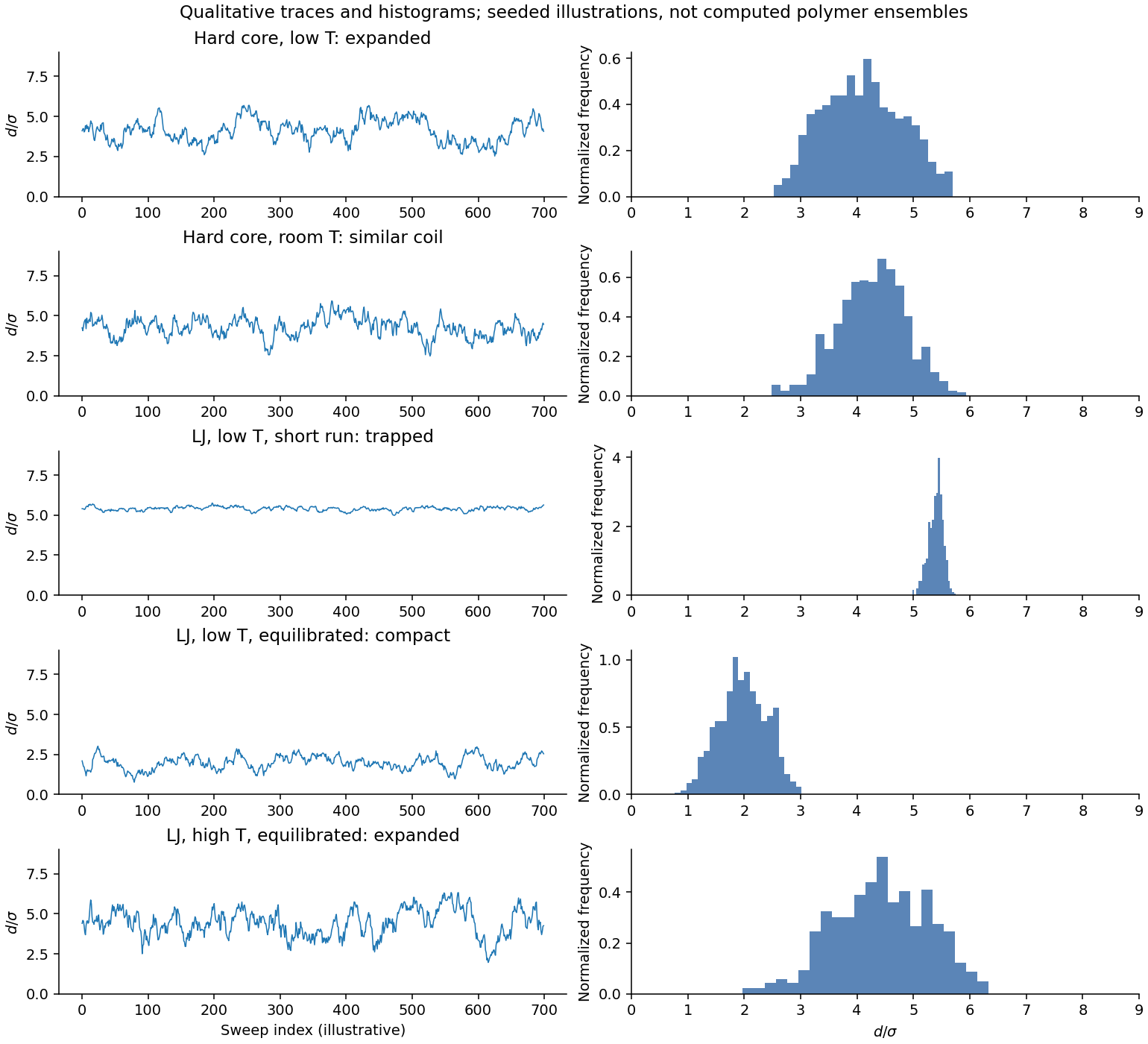
The hard-core chain does not undergo an energetic low-temperature collapse. For allowed configurations the only finite energy is bond stretching. If , bond lengths remain near and temperature mostly changes the small bond-length fluctuations, not the distribution of angular conformations. The end-to-end distance therefore fluctuates over an expanded self-avoiding-coil distribution even at low temperature, with an approximate scale and for sufficiently long three-dimensional chains.
For , the scaling is qualitative and finite-chain effects matter. An equilibrated distance-versus-sweep trace is stationary, with correlated excursions; a histogram of that trace is a distinct plot, not a curve of probability density against simulation step. Neither the temperature in kelvin nor the spring constant is specified, so an exact histogram cannot be calculated. The illustrative figure compares like-for-like coil traces rather than asserting a unique numerical simulation result.

New to topics? Read the docs here!