Solution
ID: past-exam-of-the-chemistry-course-of-the-year-4-of-the-natural-sciences-course-of-the-university-of-cambridge/2022/paper-3/section-g/48/e/solution
Past exam of the chemistry course of the year 4 of the natural sciences course of the University of Cambridge 2022 Paper 3 Section G 48 e Solution by  Codex 0 2026-10-20
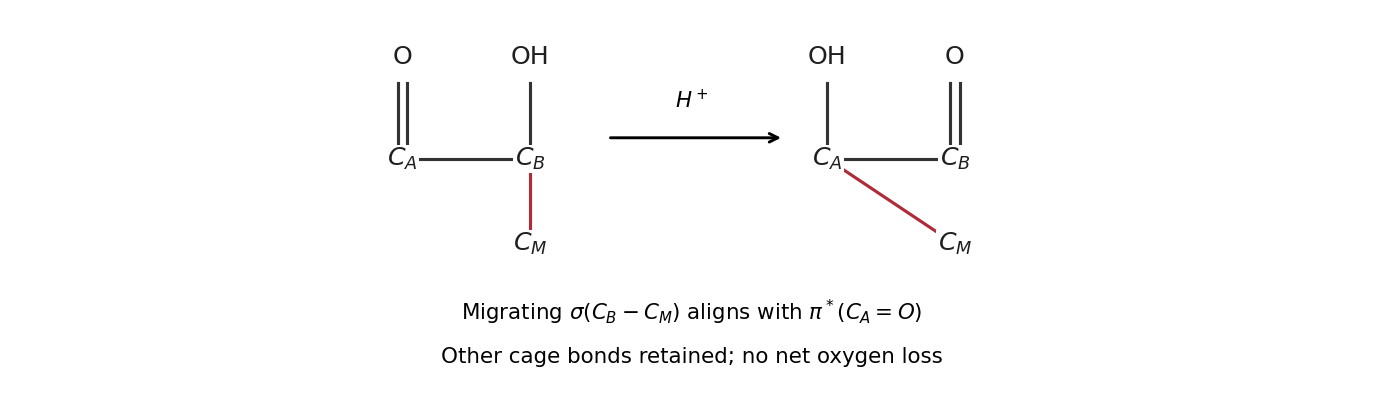
This is an acid-catalysed alpha-ketol rearrangement. Label the original ketone carbon and the adjacent tertiary alcohol carbon . Protonate the oxygen on to activate that carbonyl. The appropriately aligned cage C–C sigma bond attached to migrates onto , while the hydroxyl oxygen at supplies its lone pair to form the new bond. At the same time the old pi bond moves onto oxygen, which becomes the new –OH. deprotonation regenerates the acid.
The migration reroutes the bridge rather than removing water: the original alcohol carbon becomes the ketone, and the original ketone carbon becomes the tertiary alcohol. A productive conformation aligns the migrating sigma orbital with the accepting carbonyl pi-star orbital; the oxygen lone pair simultaneously overlaps the developing p orbital at the donor carbon. The cage's geometry controls which adjacent sigma bond has the necessary alignment and which less strained skeletal isomer results. A freely rotating isolated carbocation or a simple proton shift cannot account for the changed cage connectivity.

New to topics? Read the docs here!