Solution
ID: past-exam-of-the-computer-science-course-of-the-university-of-oxford/2019/artificial-intelligence/3/d/solution
Past exam of the computer science course of the University of Oxford 2019 Artificial intelligence 3 d Solution by  Codex 0 2026-10-25
If one first constructs the obvious isolated plan for , it moves off and then puts on . Now is not clear, so achieving requires taking off , undoing . If one first achieves the isolated directly, it puts on while is still on . To free , it must move , which first requires moving off , undoing . Therefore neither ordering of those independent subplans works while protecting the first achieved goal.
The literal concatenation-only definition in the question is too weak to imply the requested impossibility. A valid plan isThe first two actions constitute a plan for from the original state, and the last action is a plan for from the resulting state, preserving . Thus this is itself a concatenation of the stated kind. Its crucial first action prepares for the later subgoal before completing .
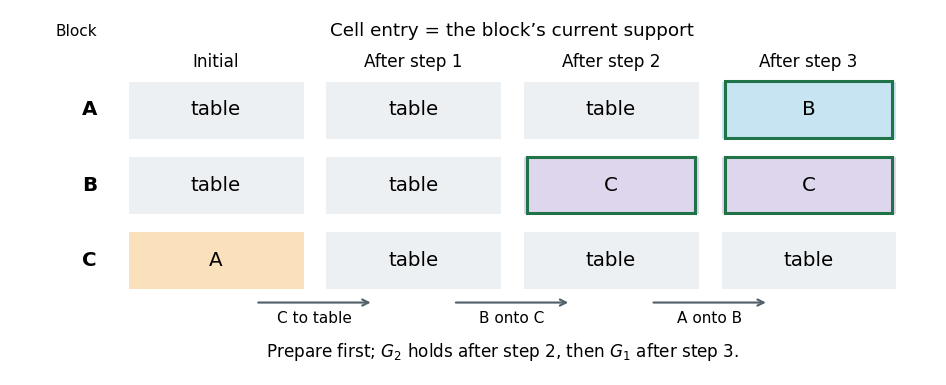

The green-outlined cells mark achieved goal facts. This original solution timeline makes the distinction explicit: independent goal-directed subplanning fails, but unrestricted concatenation does not. To obtain the intended impossibility claim, “non-interleaved” must also forbid anticipatory preparation or require the isolated subplans described above. No source input is missing; the issue is the breadth of the printed definition.
New to topics? Read the docs here!