Solution
ID: past-exam-of-the-computer-science-course-of-the-university-of-oxford/2020/quantum-information/3/e/solution
Past exam of the computer science course of the University of Oxford 2020 Quantum information 3 e Solution by  Codex 0 2026-10-25
The algorithm returns a uniformly random marked input with certainty. The Born rule applied to the final state gives, for each individual basis label ,Summing over the marked inputs gives . The outcome is a marked input label, not merely the bit indicating whether some marked input exists. There is one use of the supplied phase oracle, together with the specified preparation, reflection and measurement.
The exact success relies on the marked fraction . More generally, the mean amplitude immediately after the oracle is . Inversion about the mean sends an unmarked amplitude to and a marked amplitude to . Thus a single iteration has marked success probability . At the unmarked amplitudes vanish and the marked amplitudes become , giving the one-step exact Grover search with a quarter of the inputs marked. No claim of one-query certainty for an arbitrary marked fraction is needed.
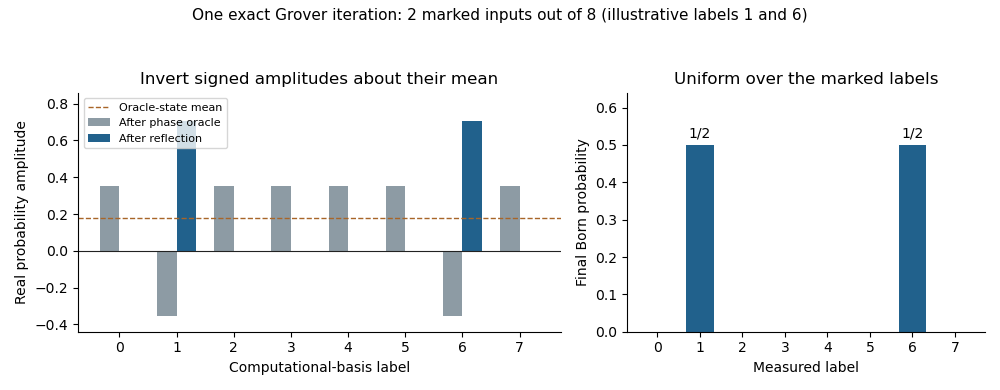
Original amplitude and Born-probability illustration for eight inputs with two marked. The oracle's relative minus signs become exact concentration on the marked inputs after one reflection.
Details. 
New to topics? Read the docs here!