Solution
ID: past-exam-of-the-condensed-matter-physics-course-of-the-university-of-oxford/2014/4/c/solution
Past exam of the condensed matter physics course of the University of Oxford 2014 4 c Solution by  Codex 0 2026-10-25
The inverse-susceptibility curve has a Curie–Weiss form above and vanishes on approach to it. The material can have spontaneous magnetization for , including the zero-temperature limit, whereas for its zero-field equilibrium state is paramagnetic. At a continuous transition the spontaneous moment tends to zero at ; divergence of differential susceptibility there is not a finite saturated permanent moment.
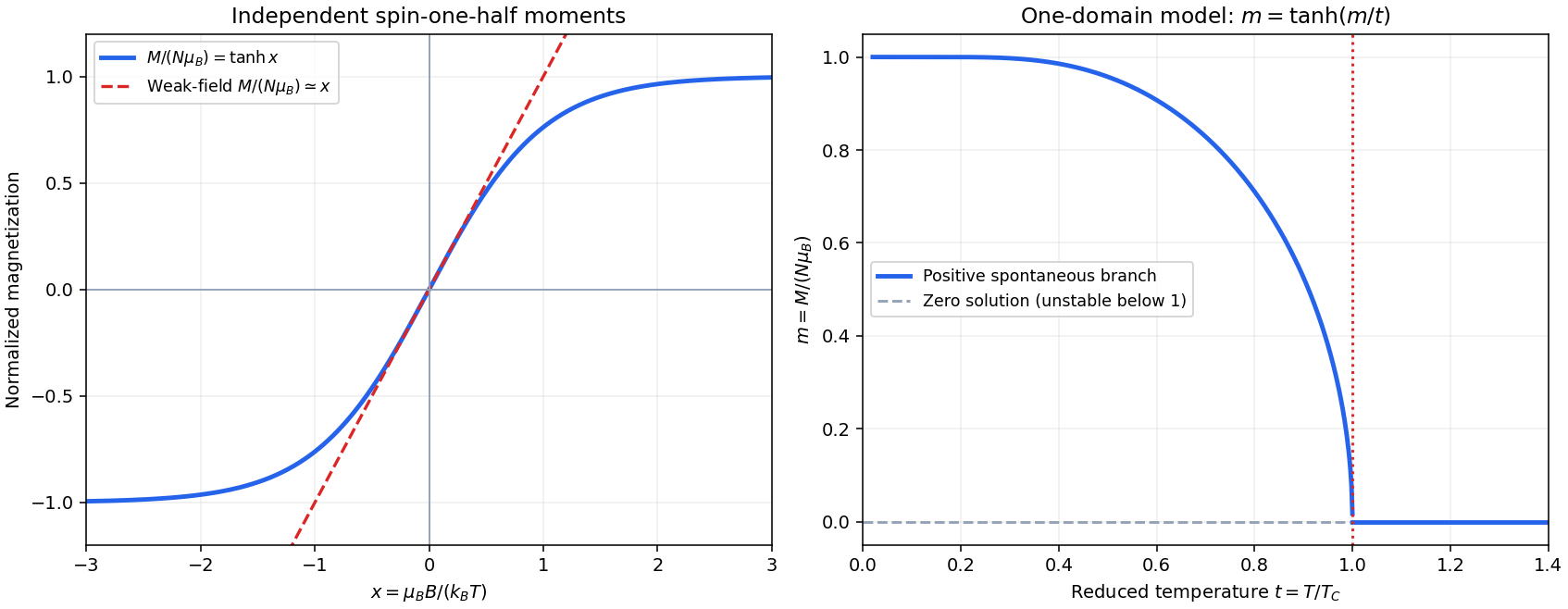
A simple Weiss molecular field model takes the effective internal field intensity to be , with positive coupling . Let be the independent-moment Curie constant. Linearizing the single-ion response on the high-temperature side givesThis explains the straight upper branch and its positive temperature intercept. At the zero-field linearized response diverges; finite field, finite size and critical fluctuations limit its use. For a spin-only two-state mean-field model the full equation is , with ; below it has nonzero zero-field solutions.
An ordering scale near corresponds to , about four orders of magnitude larger than the preceding dipolar pair scale. Exchange interaction can supply such energies: the Pauli antisymmetry of overlapping electron states changes their spatial correlations and hence Coulomb and kinetic energies according to their spin configuration. An effective ferromagnetic coupling can favor parallel moments. It is not simply the classical magnetic field of a neighbouring dipole. For example, with the convention and , the localized-spin mean-field scale is ; this illustrates why an atomic electronic interaction, rather than a bare dipolar field, can produce a high transition temperature.

New to topics? Read the docs here!