Solution
ID: past-exam-of-the-condensed-matter-physics-major-option-course-of-the-university-of-oxford/2018/1/c/ii/solution
Past exam of the condensed matter physics major option course of the University of Oxford 2018 1 c ii Solution by  Codex 0 2026-10-25
For , . The scattering triangle givesTo state signed sample angles without an implicit axis convention, take the incident beam along , positive angular rotation counterclockwise, and at choose along and along . ThenThe positive- condition is the vector equation . PutThe two detector sides then give, modulo full rotations,These pairs obey the stated same-sense sign convention and transfer momentum along . The lower-right panel below illustrates the first choice. If the initial direction is chosen on the opposite side of , a commonly used positive-angle pair is . Merely taking absolute values without fixing that crystal-axis convention can exchange and . The measurable scattering angle and the vector-triangle construction are invariant.
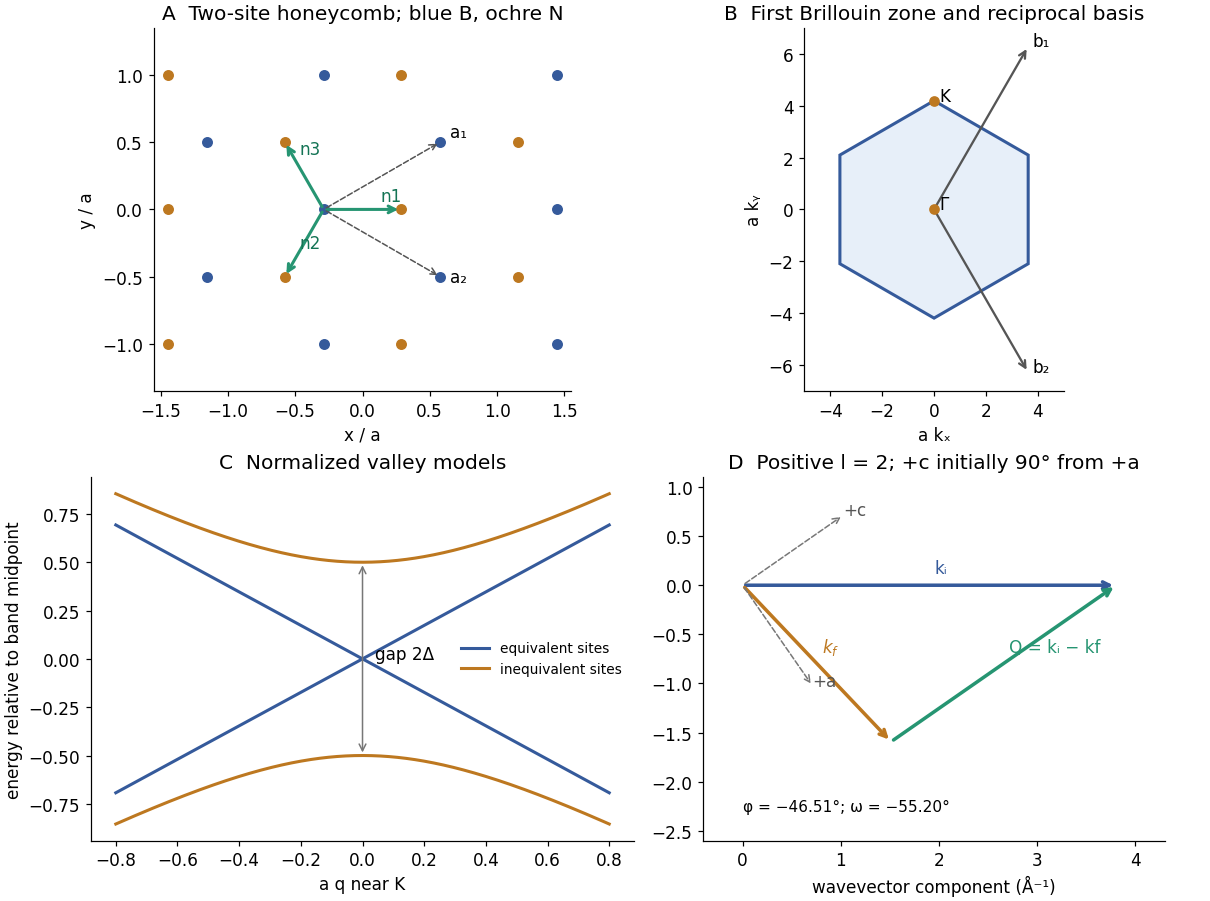
Honeycomb geometry, reciprocal-space hexagon, sublattice band gap and a signed neutron-scattering triangle
. Original calculations and schematic geometry. Lattice panels use ; the band panel compares normalized two-sublattice models. The neutron panel uses the explicit signed-axis convention of Question 1(c)(ii). Details.
New to topics? Read the docs here!