Solution
ID: past-exam-of-the-condensed-matter-physics-major-option-course-of-the-university-of-oxford/2018/3/a/solution
Past exam of the condensed matter physics major option course of the University of Oxford 2018 3 a Solution by  Codex 0 2026-10-25
Use the explicit convention , counting every bond once and taking dimensionless spins of length . On the simple cubic lattice there are six nearest and twelve face-diagonal next-nearest neighbours.
For type I all six nearest bonds are antiparallel and all twelve next-nearest bonds parallel, so . Choose the parallel direction of type II as . It has two parallel and four antiparallel nearest bonds, and four parallel face diagonals but eight antiparallel diagonals. Thus andConsequently, for the stated antiferromagnetic exchanges,This comparison is also consistent with the full classical spiral energy. With ,It is affine in each , so some minimum occurs at a cube vertex, giving the competing collinear states above. At the boundary, the coefficient of vanishes for , producing the larger degeneracy and permutations. It is not an isolated two-state crossing. The first panel of the model figure below shows the competing energies.
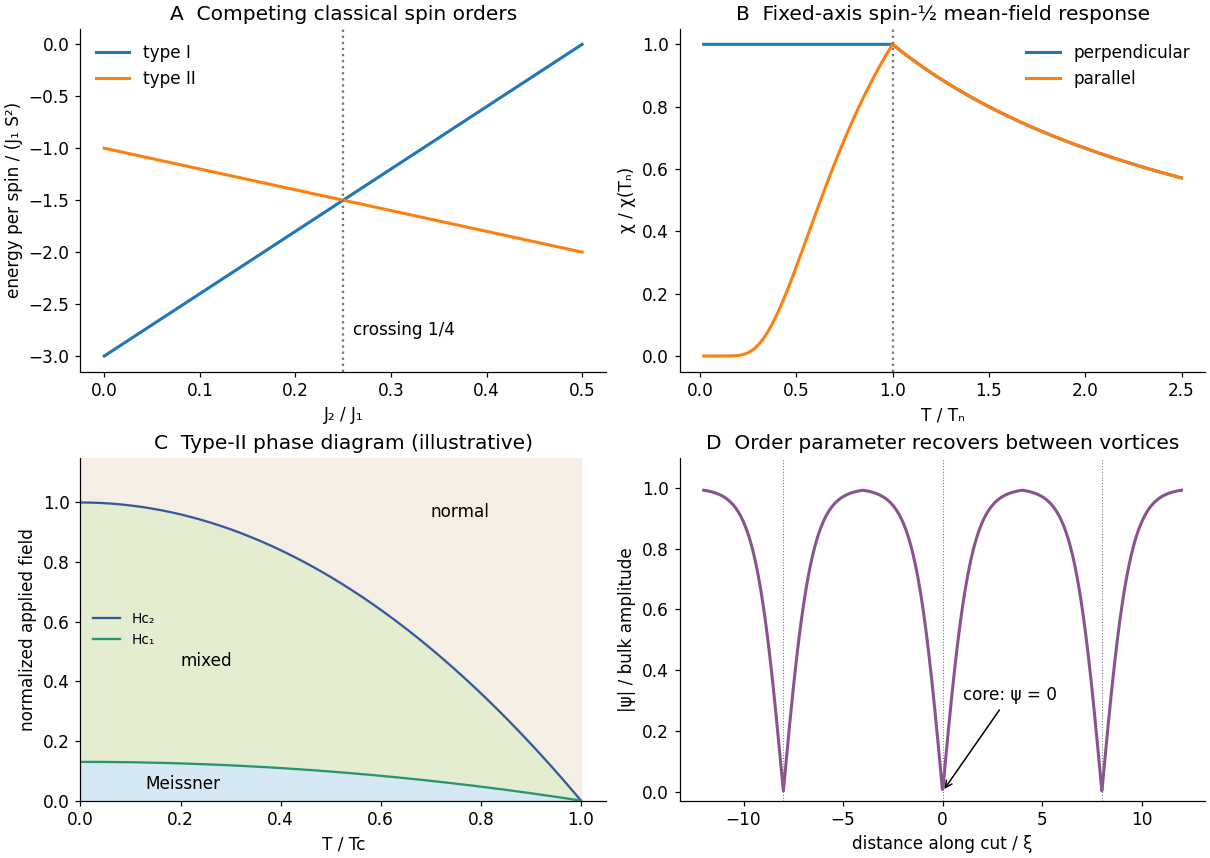
Competing antiferromagnetic energies, mean-field susceptibilities, a type-II phase diagram and vortex cores
. Original illustrative models. Susceptibilities use spin-one-half mean-field theory, fields in the phase diagram are normalized, and the order-parameter profile is a schematic cut through separated vortex cores. Details.
New to topics? Read the docs here!