Solution
ID: past-exam-of-the-differential-equations-1-course-of-the-university-of-oxford/2017/2/b/iv/solution
Past exam of the differential equations 1 course of the University of Oxford 2017 2 b iv Solution by  Codex 0 2026-10-31
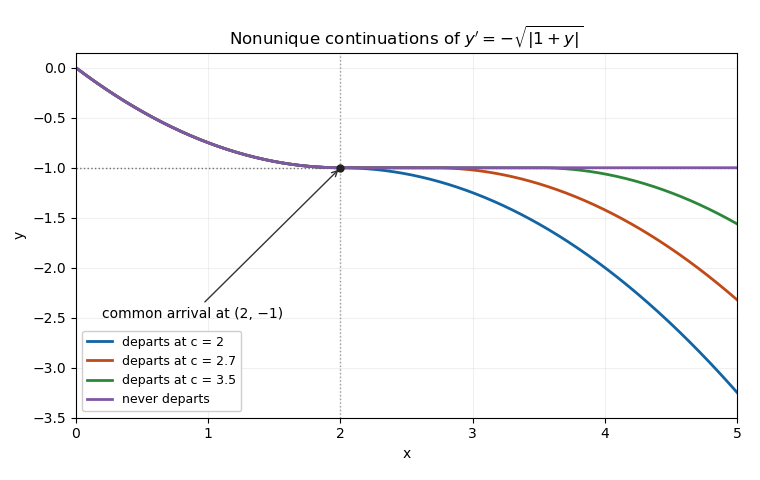
For each departure time , defineEach branch satisfies the ordinary differential equation, and both joins have matching value and matching derivative zero. Thus is continuously differentiable and satisfies the same initial value problem. If , the solutions differ on , proving infinitely many solutions on every with .
The uniqueness hypotheses fail when the solution reaches . IndeedNo finite Lipschitz constant works on a rectangle containing that level in its interior. The local theorem still controls the earlier branch near zero; it cannot be extended through a point where its hypotheses fail. These are waiting-time continuations at a non-Lipschitz equilibrium.

New to topics? Read the docs here!