Solution
ID: past-exam-of-the-formation-of-structure-in-the-universe-course-of-the-university-of-cambridge/2016/paper-1/1/a/solution
Past exam of the formation of Structure in the Universe course of the University of Cambridge 2016 Paper 1 1 a Solution by  Codex 0 2026-10-20
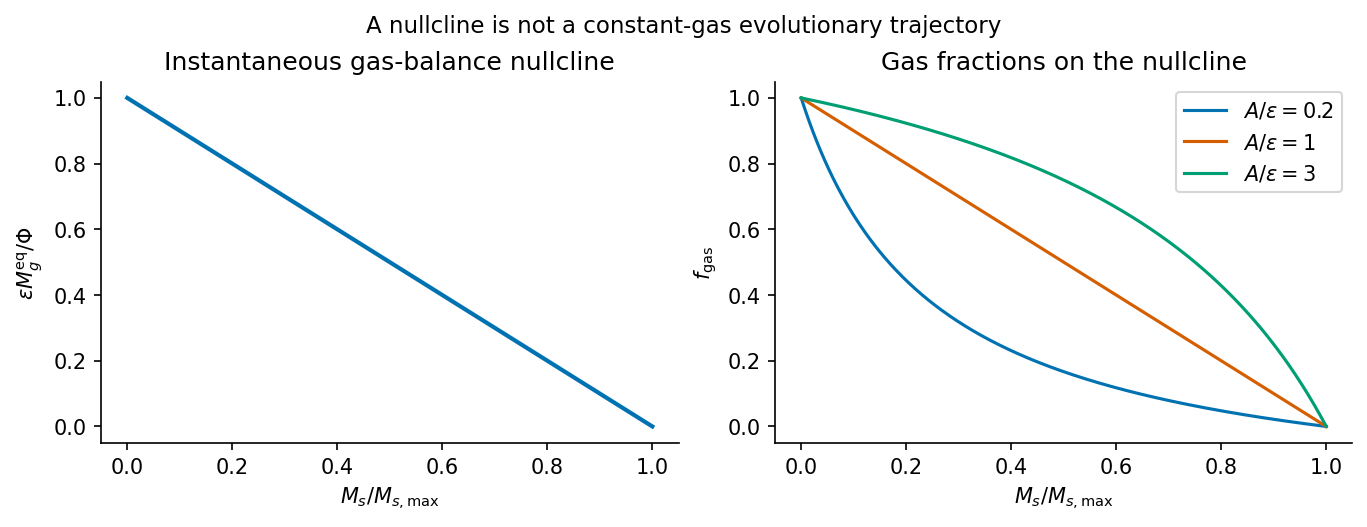
Write , where . For ionized hydrogen with Thomson scattering opacity, radiation force on one electron-proton pair balances gravity whenThe mass-loading coefficient has units of inverse time. With the stated neglect of returned and directly accreted gas, mass conservation givesAt a specified stellar mass, the gas-balance nullcline isA positive reservoir exists only below the limiting massEquality has zero gas, so this is the supremum of masses with a positive instantaneous equilibrium. For , the corresponding gas fraction isIt decreases from one to zero: the derivative is . This is a gas regulator with an outflow increasing with the stellar mass through the assumed black-hole scaling.
There is an important time-dependence qualification. A positive gas mass cannot remain exactly constant forever while the stellar mass continues to increase and is maintained: differentiating would require . The expression above is the instantaneous equilibrium, or a quasisteady approximation when gas relaxation is fast relative to stellar-mass evolution. The only exact fixed point of the coupled idealized equations is . It is not a sustained star-forming state.
Above the limiting mass, for every nonnegative reservoir: the assumed Eddington-driven wind already demands more than the incoming supply, even before star formation consumes gas. The reservoir is depleted and star formation is quenched. The equations must cease to apply when gas runs out; one cannot continue to negative gas mass or power an indefinitely Eddington-luminous nucleus without fuel. At fixed the depletion time from isAllowing to grow only strengthens the initial depletion tendency. If , this particular feedback threshold is absent.

New to topics? Read the docs here!