Solution
ID: past-exam-of-the-gauge-field-theory-course-of-the-university-of-cambridge/2016/paper-1/3/solution
Past exam of the gauge field theory course of the University of Cambridge 2016 Paper 1 3 Solution by  Codex 0 2026-10-20
There are four relevant tree-level Feynman diagrams: -channel photon, Z boson and Higgs boson exchange, and -channel electron-neutrino exchange. The electron and Positron are incoming, and and outgoing. The Higgs diagram is normally tiny because its electron coupling is proportional to ; it should nevertheless be included in the requested list.
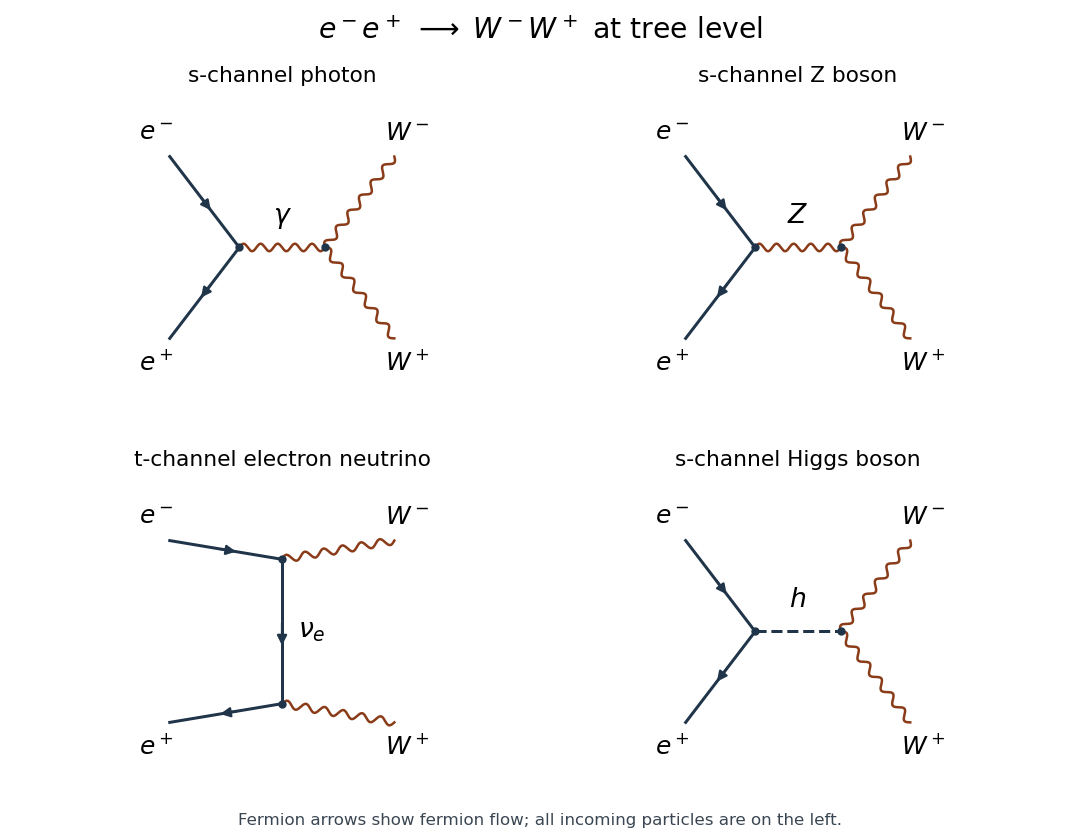

Let . The Higgs-electron coupling is , while the Higgs boson coupling to W bosons is . Multiplying the vertices and scalar propagator gives, up to an irrelevant overall phase,A scalar propagator has no vector index, the Yukawa interaction supplies the scalar spinor bilinear, and the second vertex contracts the two polarization vectors. We retain the tree propagator and neglect widths, consistently with the stated leading-order calculation.
For unpolarized incoming beams the spin average is , not a sum without normalization. The fermion spin sums and gamma-matrix trace identities giveThe terms with one gamma matrix have zero trace; the two-gamma trace gives . Both final polarization states are specified as longitudinal, so no final polarization average is appropriate.
In the centre-of-momentum frame, take and , where and . A pair of longitudinal polarization vectors isEach obeys and . Their contraction is angle independent:Consequently
For the two-body scattering cross section, the outgoing-to-incoming momentum ratio isThe source's final sentence interchanges the particle names attached to these two momenta; physical final-state phase space and initial-state flux fix the ratio as written here. Since the Higgs-only spin-averaged expression is isotropic, integrating the solid angle gives :There is no identical-particle factor: and are distinguishable. The threshold factor makes this contribution vanish when the outgoing momentum vanishes. This is the isolated squared Higgs amplitude for a specified longitudinal pair, not the complete physical cross section: the full result squares the coherent sum of all four amplitudes and includes their interference.
New to topics? Read the docs here!