A solid angle measures how much of the surrounding directions a region occupies, as seen from a specified point . Draw a sphere of radius centered at and mark where those directions meet its surface. If the marked patch has surface area , thenA Euclidean similarity scales both and by the same factor, so the chosen radius does not affect the answer. On the unit two-sphere, the numerical value is simply the patch's surface area. Unlike an angle drawn in one plane, a solid angle measures coverage in two angular directions.
For example, the full sphere has surface area and hence solid angle steradians. A hemisphere occupies steradians. Three mutually perpendicular coordinate planes divide the directions into eight congruent pieces, so each octant occupies steradians. A solid angle of one steradian therefore covers of all directions, rather than one full turn.
This makes a geometric question answer a collection question. For an ideal point emitter with isotropy, equal solid angles carry equal radiant flux. A detector accepting directions of total solid angle intercepts the fraction of that emitted radiant flux, before losses. With direction-dependent radiant intensity , the accepted radiant flux is instead . The solid angle of a disk below gives an exact example where the familiar inverse-square law is only a distant-source approximation.
A steradian is the solid angle subtended at a sphere's center by a patch of surface area . The whole sphere subtends . In the SI, the steradian has unit one; retaining its symbol identifies a solid angle, just as radians identify an angle. A dimensionless quantity still needs its physical meaning specified.[ref]
A right circular cone with vertex selects all directions within a half-opening angle of its axis. Here is measured from the axis to a boundary direction, so the full opening in a meridian plane is . For , interpret the selected directions as a spherical cap; for , this is a region larger than a hemisphere.
The spherical coordinate system gives the area element on the sphere. Dividing by and integrating over the cap yieldsThe factor matters: a thin angular strip near a pole contains fewer directions than an equally wide strip near the equator. Treating equal intervals of both spherical coordinates as equal solid angles would overcount the polar directions.
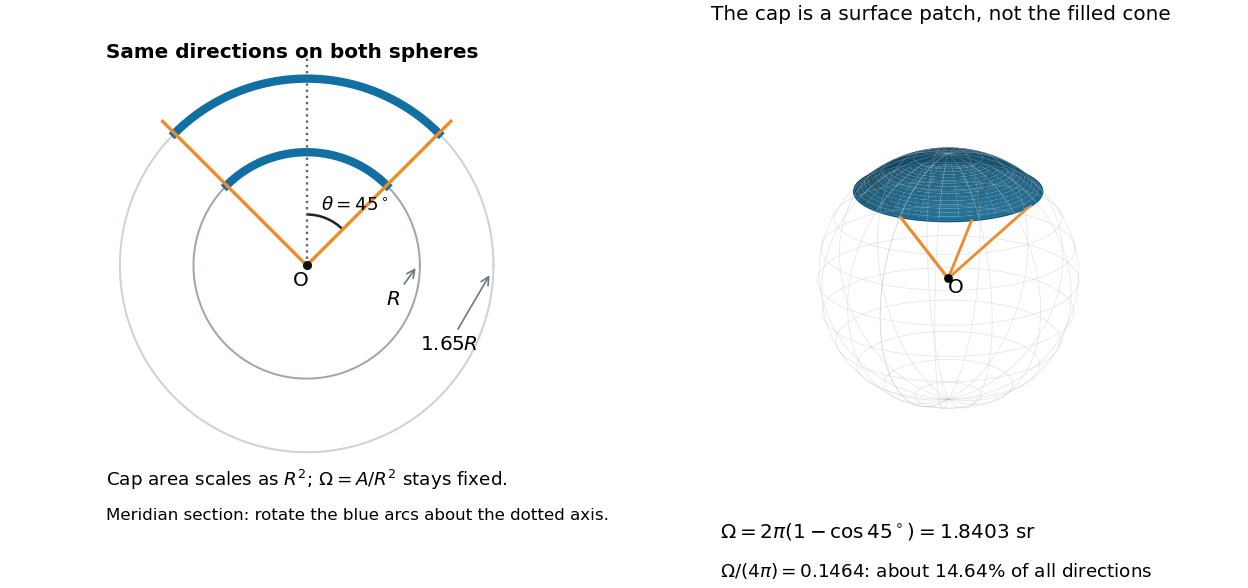
At , the solid angle is steradians, or about of all directions. At it is steradians, and at it is steradians. For a small measured in radians, the Taylor series gives the small-angle approximation . Doubling a narrow half-opening angle therefore approximately quadruples its coverage.
Consider a flat circular disk of radius , with its center a perpendicular distance from the viewpoint . The line from to its center is normal to the disk. Its rim defines a right circular cone with and . The solid angle of a circular cone immediately givesFor , this is the same half-opening example: about steradians. Both the radius and distance enter; doubling both leaves the solid angle unchanged.
A useful local version applies to a small surface patch of area , at distance from . If is the angle between its unit normal and the line to , its unsigned geometric contribution isThe numerator is the projected area. For a visible patch, perpendicular projection followed by radial projection onto a small piece of a sphere gives this formula. Integrating counts the directions once provided no direction encounters multiple counted patches. For an opaque detector, use its unoccluded face. At grazing view, the projected area tends to zero.
For this on-axis disk, a ring of radius has and . Its polar coordinates gives , so the same answer follows directly from the surface integral:The changing distance and obliquity are both already accounted for; an extra detector-wide cosine factor would count the projection twice.
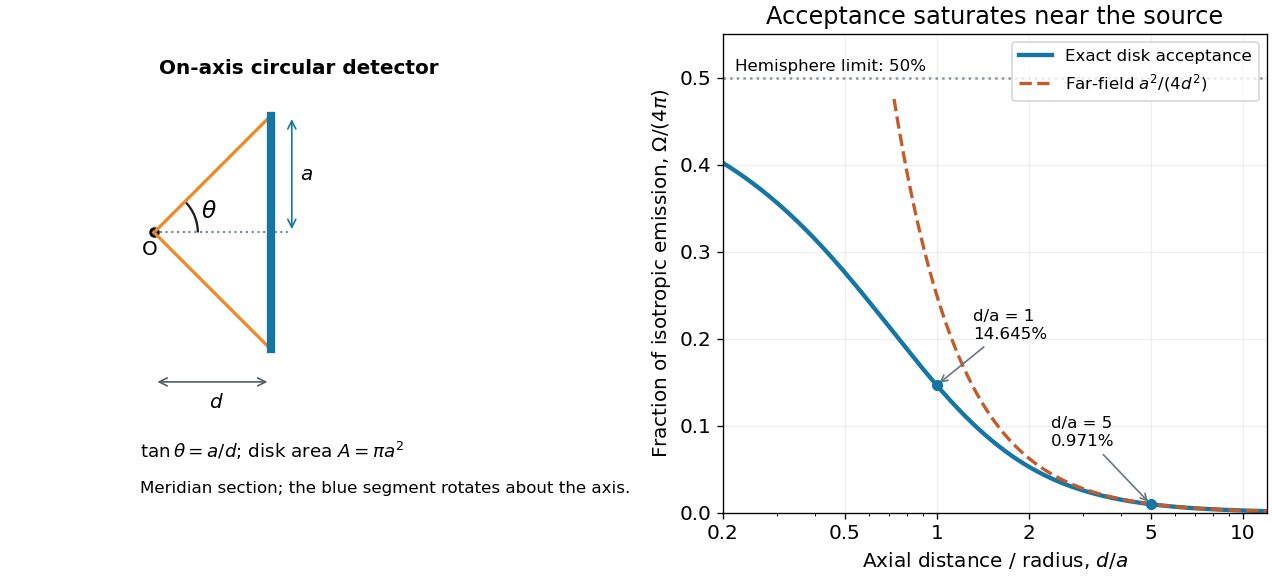
For , the Taylor series of givesThus the accepted fraction of an ideal point emitter's isotropic output is approximately , where . This is the geometry behind the inverse-square law for a small detector. At fixed , however, taking gives , so the accepted fraction approaches rather than diverging.
For a chosen numerical example, let and . The exact solid angle is approximately steradians, giving an acceptance fraction . An ideal point emitter with isotropy and total radiant flux would therefore send about onto the disk. The distant-source approximation gives , about high. This calculation assumes unobstructed propagation and counts incident radiant flux; photon absorption, detector response, and any optical attenuator require separate factors.
The normalized angular average is over the unit sphere, with solid angle measure . Rotational symmetry gives , , and . The constants follow by contracting indices and using . These identities extract photon angular temperature moments. For normalized spherical harmonics, ; their angular average instead has an extra factor .
Articles by others on the same topic



A solid angle is a measure of how large an object appears to an observer from a particular point of view, and it indicates the two-dimensional angle in three-dimensional space. Solid angles are measured in steradians (sr), where one steradian corresponds to the solid angle subtended at the center of a sphere by an area on its surface equal to the square of the sphere's radius.