Solution
ID: past-exam-of-the-general-relativity-course-of-the-university-of-oxford/2022/3/a/solution
Past exam of the general relativity course of the University of Oxford 2022 3 a Solution by  Codex 0 2026-10-25
A photon follows a null geodesic, whose spatial path approaches straight lines far from the deflecting mass. Extend the incoming asymptote forward: this is the reference path the photon would follow if the mass were removed while its incoming direction and transverse offset were held fixed. The impact parameter is the perpendicular distance from the mass to that incoming asymptote. It is not, in general, the distance of closest approach.
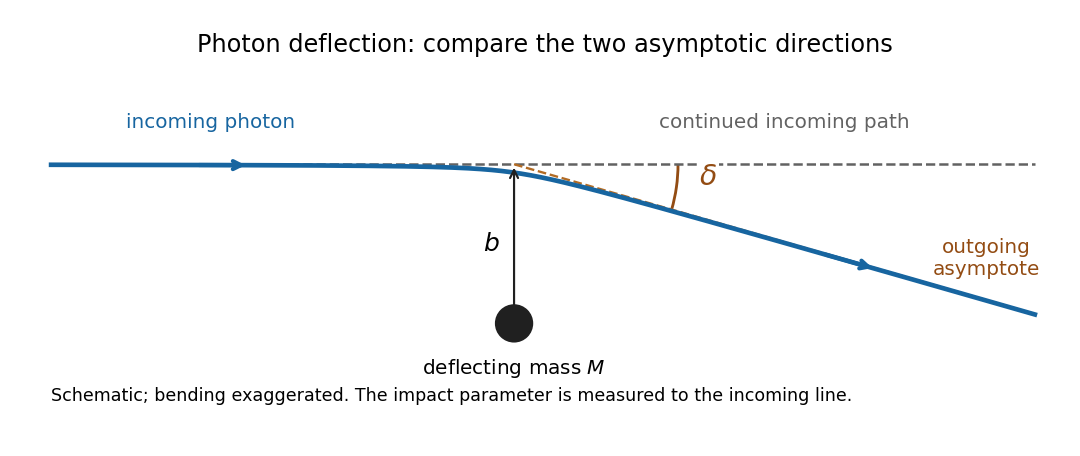
Impact parameter and deflection relative to the continued incoming photon path
. Original schematic, with bending exaggerated. The dashed horizontal line is the undeflected reference path. The outgoing dashed asymptote makes angle delta with it; b is measured to the incoming asymptote, not to the bent ray. Details.
The positive deflection angle is the angle between the outgoing propagation direction and the continued incoming direction. The photon bends toward the mass, so a ray passing above it has a downward outgoing slope in the figure. In the weak-field approximation for an isolated spherical mass, Schwarzschild light deflection gives for distant endpoints. This angle differs from the apparent image angle measured from the observer's line of sight to the mass.
New to topics? Read the docs here!