Solution
ID: past-exam-of-the-genetics-course-of-the-university-of-cambridge/2024/paper-4/3/solution
Past exam of the genetics course of the University of Cambridge 2024 Paper 4 3 Solution by  Codex 0 2026-10-20
The target is genetic variation in a reaction norm: how pigmentation produced by a genotype changes with developmental temperature. A gene affecting pigmentation at every temperature is not necessarily a gene affecting plasticity. The design must estimate inherited differences in responsiveness separately from differences in baseline colour.
Raise replicated genotypes or families across several controlled developmental temperatures, distributing members of the same genetic background among environments. Standardize sex, age, nutrition, density and the body region scored; female posterior abdominal pigmentation is a useful defined trait. Randomize position and scoring order and quantify colour from calibrated images. Record viability and development time, since selective mortality can change the composition of survivors and imitate a plastic response. A parental common-garden generation and reciprocal crosses can help separate inherited nuclear effects from maternal or carry-over effects.
A simple mixed-effects model iswhere genotype and environment effects describe baseline differences and the shared temperature response, their interaction describes genotype-specific responses, and represents an appropriate block effect. Treating temperature as a continuous predictor gives genotype-specific slopes, but a curved response should not be forced into one line. Fit reaction norms with uncertainty and test whether their shapes differ.
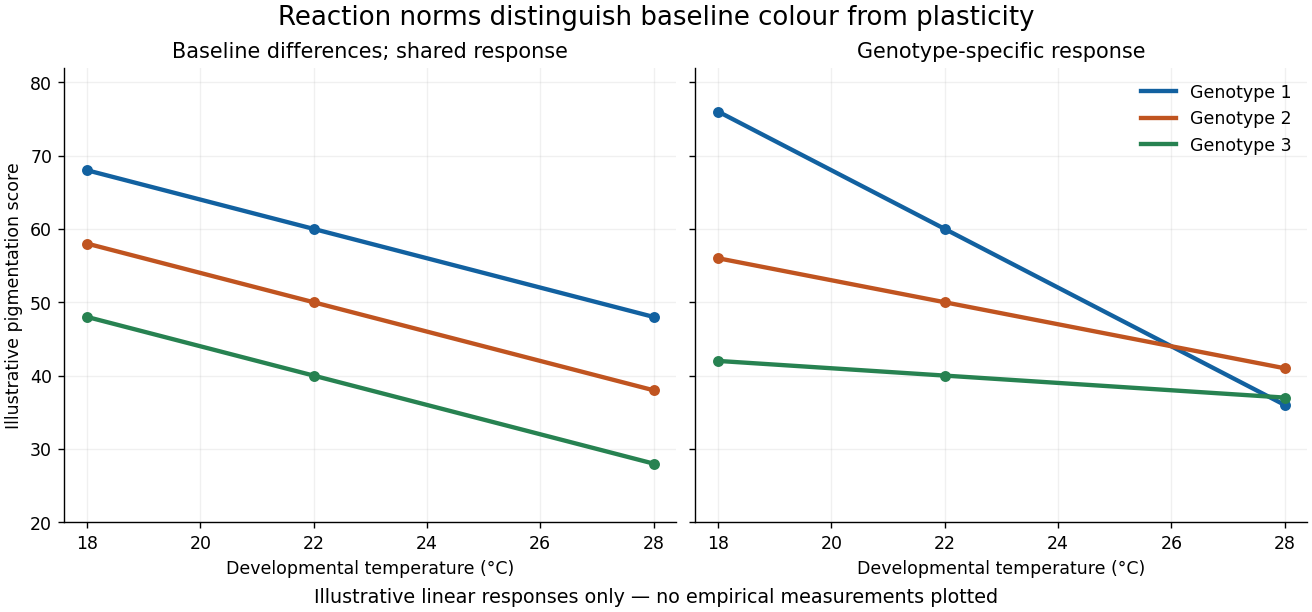
Illustrative pigmentation reaction norms separating baseline genetic differences from genotype-by-temperature interaction
. Details. 
Quantitative trait locus mapping in segregating crosses can locate loci affecting the temperature interaction. A genome-wide association study in a diverse panel can complement it, with controls for relatedness and population structure. Analyse the joint phenotype across temperatures, rather than comparing a significant association at one temperature with a nonsignificant association at another and calling the difference an interaction. Mapping resolution, power and multiple-testing correction determine how many candidate regions can be distinguished.
Follow candidates with staged expression measurements, chromatin assays and functional perturbations. A coding change might alter enzyme temperature sensitivity; a cis-regulatory change might alter where or when the enzyme is produced; a trans-acting chromatin or hormonal regulator could affect several pathways. Allele-specific expression in a shared trans environment can help distinguish cis from trans effects. Replacing an allele or rescuing a perturbation and then measuring the entire reaction norm tests causality more strongly than expression correlation alone.
The expectation is a context-dependent genetic network, potentially including pigmentation enzymes, developmental regulators and chromatin regulation. Jean-Michel Gibert and colleagues found temperature-sensitive regulation involving Abdominal-B, bric-à-brac and chromatin regulators in female abdominal pigmentation. That supports a distributed mechanism rather than a universal dedicated plasticity gene. It does not imply that the same causal variants explain every natural population or all body regions.[ref]
Phenotypic Plasticity in Drosophila Pigmentation Caused by Temperature Sensitivity of a Chromatin Regulator Network by Jean-Michel Gibert and others. Temperature, regional developmental regulation and pigmentation-enzyme expression
Thus one may find variants affecting baseline colour, slope or curvature, as well as environment-dependent dominance and epistasis. Some apparent interactions may disappear after controlling development stage or survival. Demonstrating heritable plasticity does not establish that it is adaptive: that further claim requires fitness comparisons in the relevant environments.
New to topics? Read the docs here!