Solution
ID: past-exam-of-the-graph-theory-and-probabilistic-combinatorics-course-of-the-university-of-oxford/2007/b/8/d/solution
Past exam of the graph Theory and Probabilistic Combinatorics course of the University of Oxford 2007 B 8 d Solution by  Codex 0 2026-10-31
For , make one block from the edge weights . These blocks are independent because they contain disjoint edges. Changing one whole block only changes weights of edges incident with vertex . Every matching contains at most one such edge, so its total weight changes by at most one. Comparing an old optimal matching in the new weights and a new optimal matching in the old weights proves that the maximum matching weight also changes by at most one.
Apply the bounded-differences martingale argument to these blocks, givingExposing each edge separately would give a weaker quadratic-in- denominator. The grouped exposure is what supplies the requested linear denominator. The proof needs only independent weights in , not identical uniform laws. For , the matching weight is deterministically zero; the divided formula is intended for .
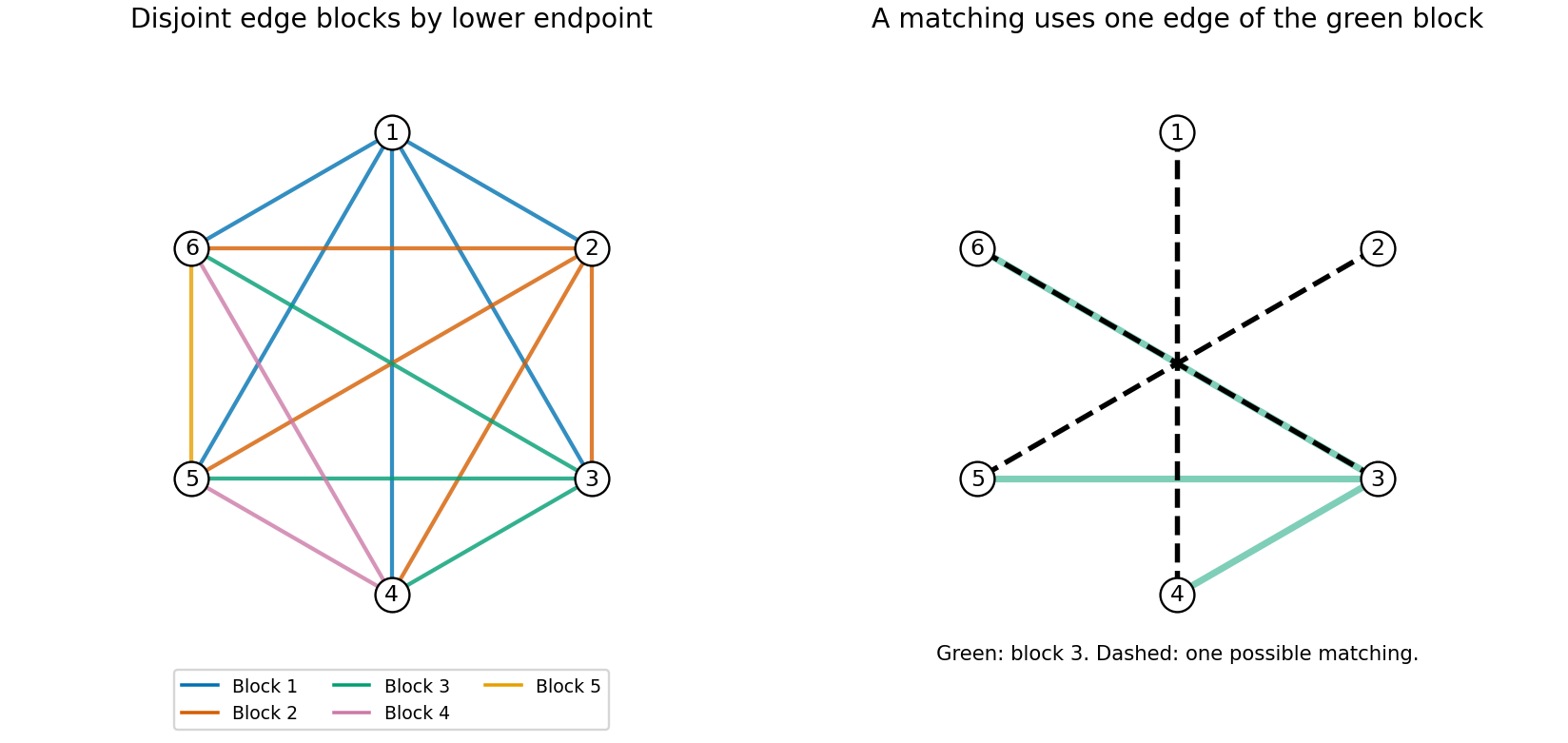
Independent blocks for revealing matching weights
. Each edge is assigned to its lower-numbered endpoint. Edges in one block share a vertex, so any matching uses at most one of them. Details.
The general grouping argument is vertex-block concentration of maximum matching weight.
New to topics? Read the docs here!