Solution
ID: past-exam-of-the-materials-science-course-of-the-university-of-cambridge/2015/paper-1/6/b/solution
Past exam of the materials science course of the University of Cambridge 2015 Paper 1 6 b Solution by  Codex 0 2026-10-20
A multi-anvil press transmits a large external load through several hard anvils onto a confined pressure medium surrounding the sample. Reducing the loaded area raises pressure, while the surrounding medium and gasket limit lateral escape. A resistive heater within the assembly can heat the sample, with insulation and temperature sensing arranged around it. It provides relatively large sample volumes and useful bulk, high-temperature experimental conditions, but access to the sample and optical paths is restricted, pressure gradients and calibration matter, and the maximum pressure is constrained by anvil strength and geometry.
A diamond anvil cell squeezes a very small sample and pressure medium in a gasket hole between opposed diamond culets. Diamond combines high strength with useful optical transparency, permitting spectroscopy and optical pressure calibration as well as suitable X-ray access. Heating can be external or laser-based. The very small contact area permits high pressure from a modest total force, but gives a tiny sample volume. Nonhydrostatic stress, pressure gradients, gasket deformation, heating gradients, chemical compatibility and diamond failure are important limitations.
Neither device generates pressure by force alone independent of area and confinement. Nor does a nominal force-to-area ratio guarantee a known hydrostatic sample pressure; experimental pressure and temperature must be calibrated. The two assemblies trade sample volume and access against pressure reach rather than one being universally preferable.
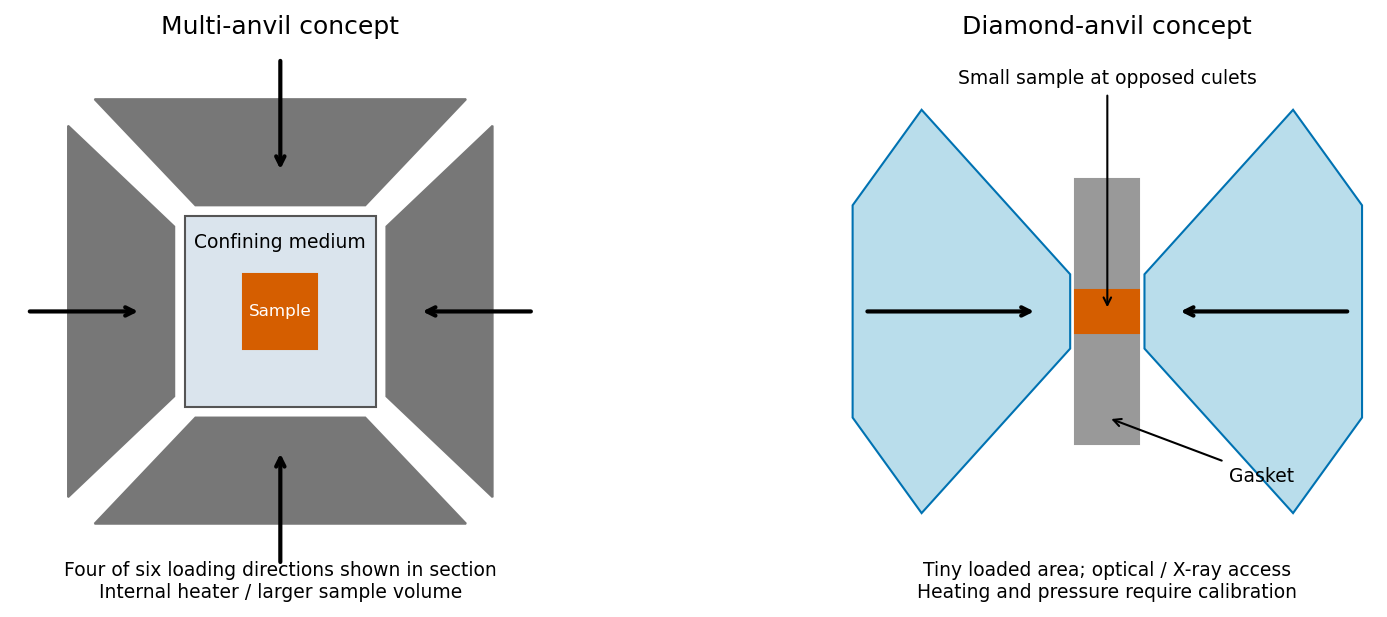
Original conceptual comparison of multi-anvil load transmission and opposed diamond culets, showing confinement and qualitative heating/access tradeoffs
. Details. 
New to topics? Read the docs here!